Join Professional Online Mushroom Cultivation Training
Learn practical commercial mushroom farming, substrate treatment, climate control & mandi sales from home with live expert assistance.
Mushroom Farming Training in India: ICAR-IIHR, DMR Solan and KVK Explained
Starting a mushroom farm involves more than purchasing spawn and preparing a growing room. Successful cultivation requires an understanding of substrate preparation, growing conditions, hygiene, crop management, harvesting and post-harvest handling.
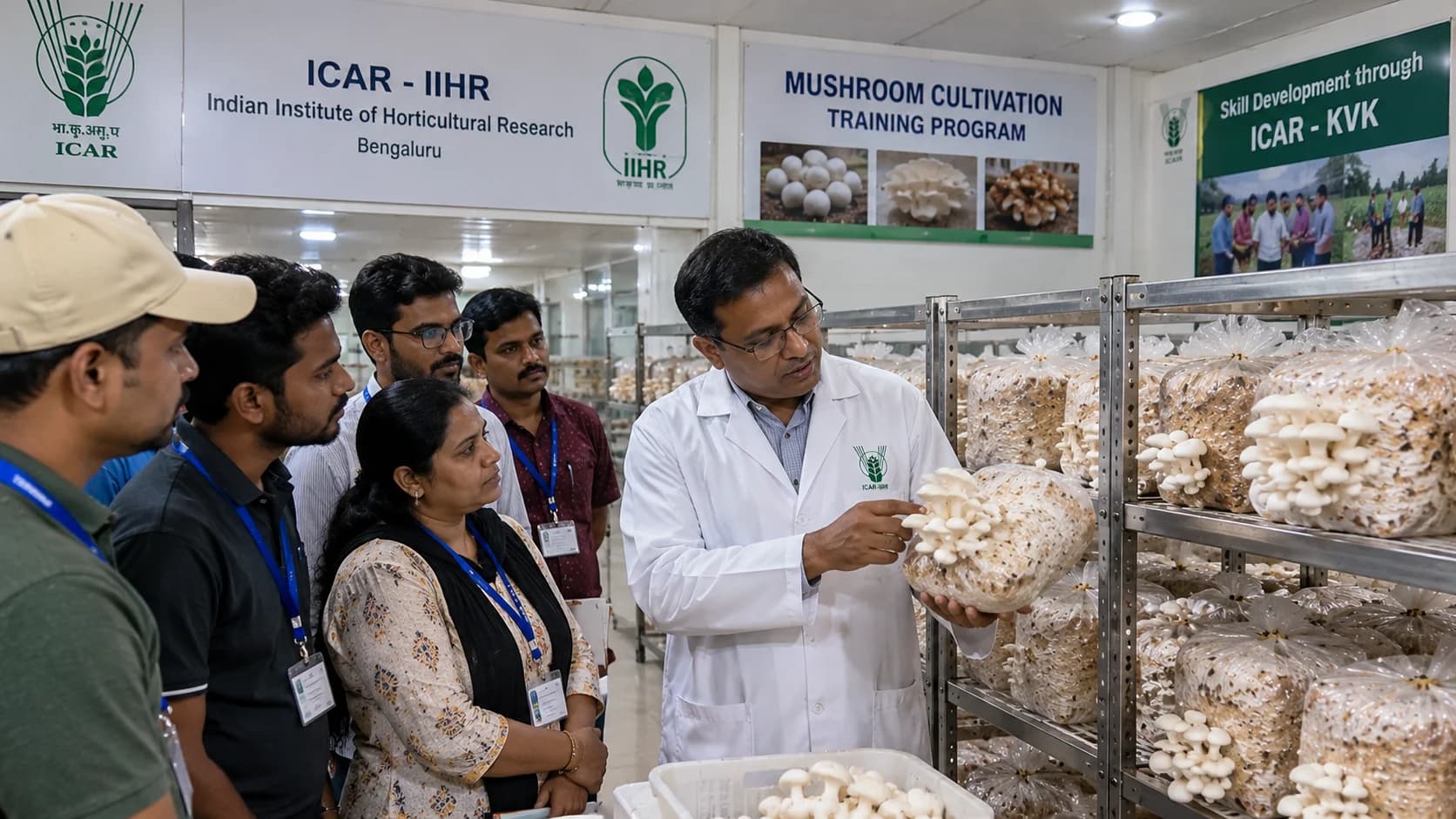
For beginners, one of the most important decisions is choosing the right source of mushroom farming training.
In India, agricultural research institutes and Krishi Vigyan Kendras (KVKs) provide different types of agricultural education, technical guidance and farmer training. Some programmes focus on scientific mushroom cultivation, while others may cover spawn production, entrepreneurship, local cultivation practices or skill development.
Three names worth exploring are ICAR-IIHR, ICAR-DMR Solan and KVKs.
However, these organisations do not necessarily offer identical courses. Their training schedules, eligibility requirements, fees, course duration and practical components can differ.
The right mushroom cultivation course depends on what you want to learn, where you live, and whether your goal is home cultivation, commercial production or mushroom spawn manufacturing.
This guide explains the differences between these training options and how to evaluate them before enrolling.
1. Why Mushroom Farming Training Matters
Mushroom cultivation is a biological production process. Even when two growers use similar rooms and growing materials, their results may differ because of variations in hygiene, substrate preparation, environmental control and crop management.
Learning the process systematically can help beginners understand the reasons behind common cultivation problems.
A useful mushroom farming training programme may cover:
- Mushroom biology and suitable species
- Spawn selection and handling
- Substrate preparation
- Pasteurisation or sterilisation methods
- Spawning and incubation care
- Casing requirements for button mushrooms
- Temperature and humidity management
- Fresh air exchange and CO2 control
- Pest and disease prevention
- Harvesting, grading, and post-harvesting
Not every course covers all these subjects in the same depth.
For example, a mushroom cultivation course may teach growers how to use purchased spawn, whereas a spawn production course may focus on laboratory techniques, culture maintenance and producing quality spawn. To explore structured online certification, visit our Mushroom Cultivation Training Portal.
Before enrolling, check the detailed syllabus rather than judging a course by its title alone.
2. Mushroom Training at ICAR-IIHR, Bengaluru
The ICAR–Indian Institute of Horticultural Research is an agricultural research institute that conducts work in horticulture, including mushroom research and cultivation technology.
Its Mushroom Research Laboratory provides information about training programmes, spawn production, mushroom cultivation and related technologies.
What Can You Learn?
The institute's published training information describes two distinct areas:
Mushroom cultivation training
The curriculum described by ICAR-IIHR includes commercial cultivation technology, different mushroom varieties, post-harvest management, product development, marketing, farm layout, sanitation, pest and disease management, and mushroom mechanisation.
Mushroom spawn production training
Spawn production training covers areas such as tissue culture, maintenance of pure cultures, mother spawn, generation spawn, cultivation spawn and spawn-unit layout.
These are different skill sets. Someone planning to operate a mushroom growing unit may primarily need cultivation training. Someone planning to establish a spawn laboratory needs a more specialised understanding of laboratory procedures and contamination control. Explore pure F1 cultures via our certified mushroom spawn seeds.
Who Should Consider ICAR-IIHR?
This option may be worth investigating if you are:
- A beginner seeking structured mushroom cultivation education.
- A farmer planning to expand into mushroom production.
- An entrepreneur interested in mushroom spawn production.
- A grower exploring different mushroom varieties.
- Someone interested in post-harvest management and value-added products.
How to Check Training Dates
Course schedules and admission availability change. Before making travel arrangements or paying fees, check the institute's current official training page.
The institute publishes course details, fees, dates and accommodation options through its website. These details should be verified for the specific batch you intend to join.
3. Mushroom Farming Training at ICAR-DMR Solan
The ICAR–Directorate of Mushroom Research is another important institution to investigate when searching for mushroom cultivation training in India.
Its work is specifically focused on mushroom research and related cultivation technologies. The National Horticulture Board also lists ICAR-DMR Solan among the institutes offering mushroom training.
What Should You Check Before Enrolling?
If you are interested in training at DMR Solan, check the current programme details for:
- Course duration and species included in syllabus.
- Practical demonstrations and hands-on laboratory time.
- Eligibility requirements, fees, registration dates, and certificate details.
- Accommodation arrangements and whether spawn production is included.
Is DMR Solan Suitable for Commercial Mushroom Farming?
It may be a useful option for people seeking formal mushroom-related training and scientific knowledge.
However, attending a course does not automatically establish that a person is ready to manage every type of commercial mushroom farm.
Commercial production also requires knowledge of infrastructure, environmental control, input costs, labour, market demand, storage and distribution. For detailed commercial SOPs, read our guide on button mushroom commercial SOPs or explore turnkey farm setup consultation.
4. What Is KVK Mushroom Farming Training?
KVK stands for Krishi Vigyan Kendra. KVKs operate within India's agricultural extension system and work to communicate agricultural knowledge and technologies to farmers and other stakeholders.
Depending on the centre and its programme, training may include demonstrations, farmer education, vocational skill development and locally relevant cultivation guidance.
What Makes KVK Training Different?
KVK programmes may be particularly relevant to farmers looking for agricultural guidance closer to their home district.
Potential advantages include:
- Easier access to local agricultural extension services.
- Training that considers regional farming conditions.
- Demonstrations relevant to local crops and agricultural practices.
- Information about local agricultural support programmes where available.
Contact your nearest KVK directly to ask whether mushroom cultivation training is currently available. Do not assume that every KVK offers spawn production or commercial button mushroom management.
5. ICAR-IIHR vs DMR Solan vs KVK: Which Should You Choose?
The best choice depends on your learning objective.
| Factor | ICAR-IIHR | ICAR-DMR Solan | KVK |
|---|---|---|---|
| Main focus | Horticultural research, mushroom cultivation & spawn tech | Mushroom-focused research and related technologies | Agricultural extension and farmer training |
| Spawn production | Dedicated lab training available | Check current syllabus | Depends on individual centre |
| Cultivation training | Published programmes | Check available courses | Local training activities |
| Location | Bengaluru, Karnataka | Solan, Himachal Pradesh | Across different districts |
Which Is Best for Beginners?
A beginner should look for a programme that explains the complete cultivation cycle, provides practical demonstrations, and allows questions about common growing problems. Read our beginner guide on how to grow mushrooms at home.
Which Is Best for Spawn Production?
If your goal is to produce spawn commercially, prioritise a course that explicitly covers pure culture maintenance, laboratory hygiene, mother spawn, generation spawn, contamination prevention and spawn quality assessment.
Which Is Best for Local Farmers?
A nearby KVK may be a practical first contact, especially if you want region-specific agricultural guidance and do not want to travel far for an introductory programme.
6. What Should You Learn Before Starting a Commercial Mushroom Farm?
Choosing an institution is only the first step. The course content should match the production system you want to operate.
Before investing in a commercial mushroom farm, understand:
- Mushroom Variety Selection: Oyster, button and milky mushrooms have different climate and substrate requirements.
- Substrate Preparation: Correct pasteurisation/sterilisation to prevent competitive green molds (*Trichoderma*).
- Environmental Management: Temperature, relative humidity, fresh air exchange and CO2 control. See our detailed comparisons on AC vs Fogger for mushroom farming and AC tonnage calculations.
- Farm Economics & Marketing: Capital expenditure, running costs, labor, packaging, cold storage, and sales channels. Learn marketing strategies in our guide on how to sell oyster mushrooms in local mandis.
7. Is a Mushroom Farming Certificate Enough to Start a Business?
A certificate can document participation in or completion of a particular programme, according to the institution's rules. However, it does not automatically demonstrate that the holder can independently operate every type of mushroom farm.
Practical competence develops through a combination of instruction, supervised work, observation and experience. Check equipment availability in our mushroom farming equipment catalog.
8. How to Select the Right Mushroom Cultivation Course
Use this checklist before paying a training fee:
- Check syllabus for your chosen mushroom species
- Ask about practical hands-on substrate sessions
- Confirm course duration and full fee structure
- Verify post-training technical consultation support
9. Frequently Asked Questions
Where can I get mushroom farming training in India?
You can investigate ICAR-IIHR, ICAR-DMR Solan and relevant KVKs. Training availability, course content and fees vary, so check each institution's current official information.
Does ICAR-IIHR offer mushroom cultivation training?
Yes. ICAR-IIHR's Mushroom Research Laboratory publishes information about mushroom cultivation and spawn production training. Check its official website for the current schedule and registration details.
What is the difference between mushroom cultivation and spawn production training?
Cultivation training focuses on growing mushrooms through the production cycle. Spawn production training focuses on producing mushroom planting material using appropriate cultures and laboratory procedures.
Can I learn mushroom farming through a KVK?
Some KVKs conduct mushroom-related training or skill-development programmes. Availability depends on the centre and its current activities.
Which training is suitable for commercial mushroom farming?
Choose a programme that matches your intended species and scale of production. Commercial growers should also understand infrastructure, environmental management, economics, harvesting and marketing.
Does mushroom training guarantee a profitable business?
No. Training can improve knowledge and practical skills, but profitability depends on production performance, investment, operating costs, market demand and business management.
Should I complete training before buying mushroom farm equipment?
It is generally sensible to understand the production requirements before making major equipment purchases. Training can help you identify what your chosen cultivation system actually needs.
Conclusion
India offers several routes for learning mushroom cultivation, including specialised research institutes and agricultural extension centres.
ICAR-IIHR publishes information about mushroom cultivation and spawn production training. ICAR-DMR Solan is another important mushroom research institution to investigate. KVKs may provide regionally relevant agricultural education and mushroom-related programmes, depending on the centre.
The most suitable option is not necessarily the institution with the most recognisable name. It is the programme that teaches the skills you need for your intended production system.
Good mushroom farming begins with the right technical knowledge, realistic planning and consistent implementation—not simply with a training certificate.
Start Your Certified Online Mushroom Cultivation Training Today
Join thousands of successful growers across India. Learn Oyster, Button & Milky mushroom farming step-by-step from certified experts with lifetime technical support.
Recommended Mushroom Cultivation & Setup Guides
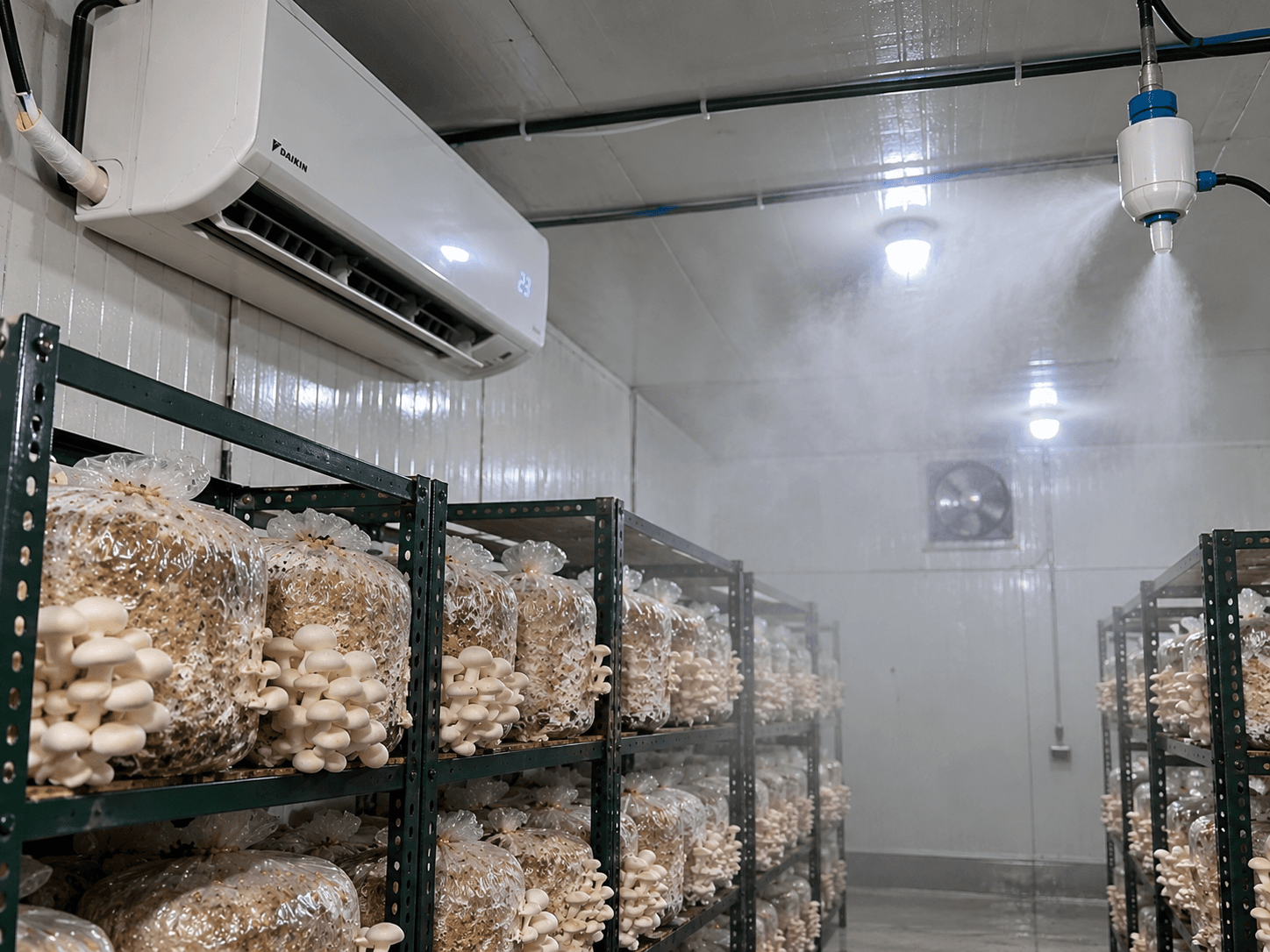
AC vs Fogger for Mushroom Farming: Which One Do You Actually Need?
Compare AC vs fogger for mushroom farming: understand temperature vs humidity control, evaporative cooling limits, electricity costs, and coordinating both systems.
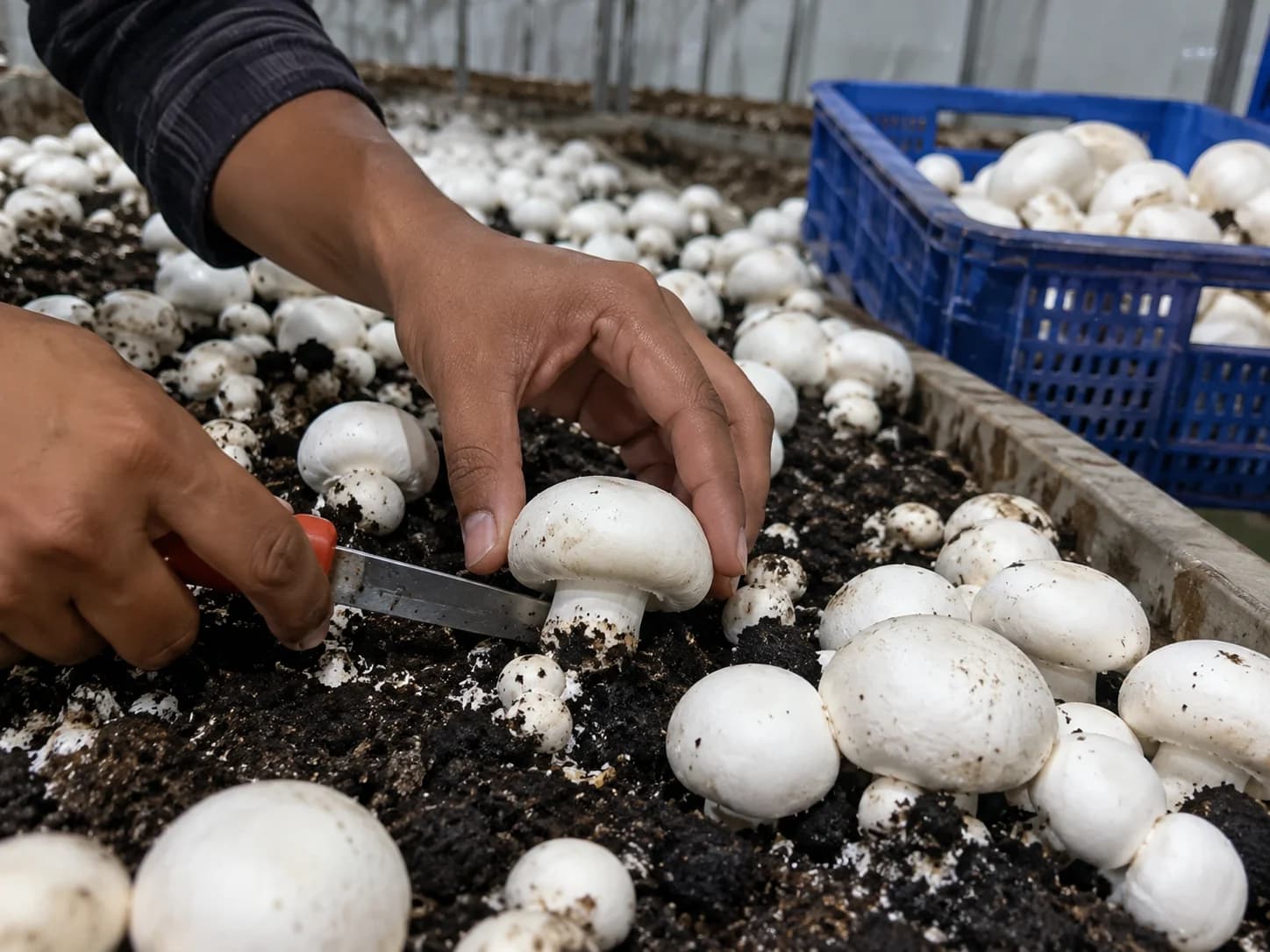
How to Cut Button Mushrooms: The Right Harvesting Method for Better Quality
Learn how to harvest button mushrooms correctly: should you cut with a knife or twist by hand? Complete stem trimming guide, tools, timing, flush care, and commercial quality tips.
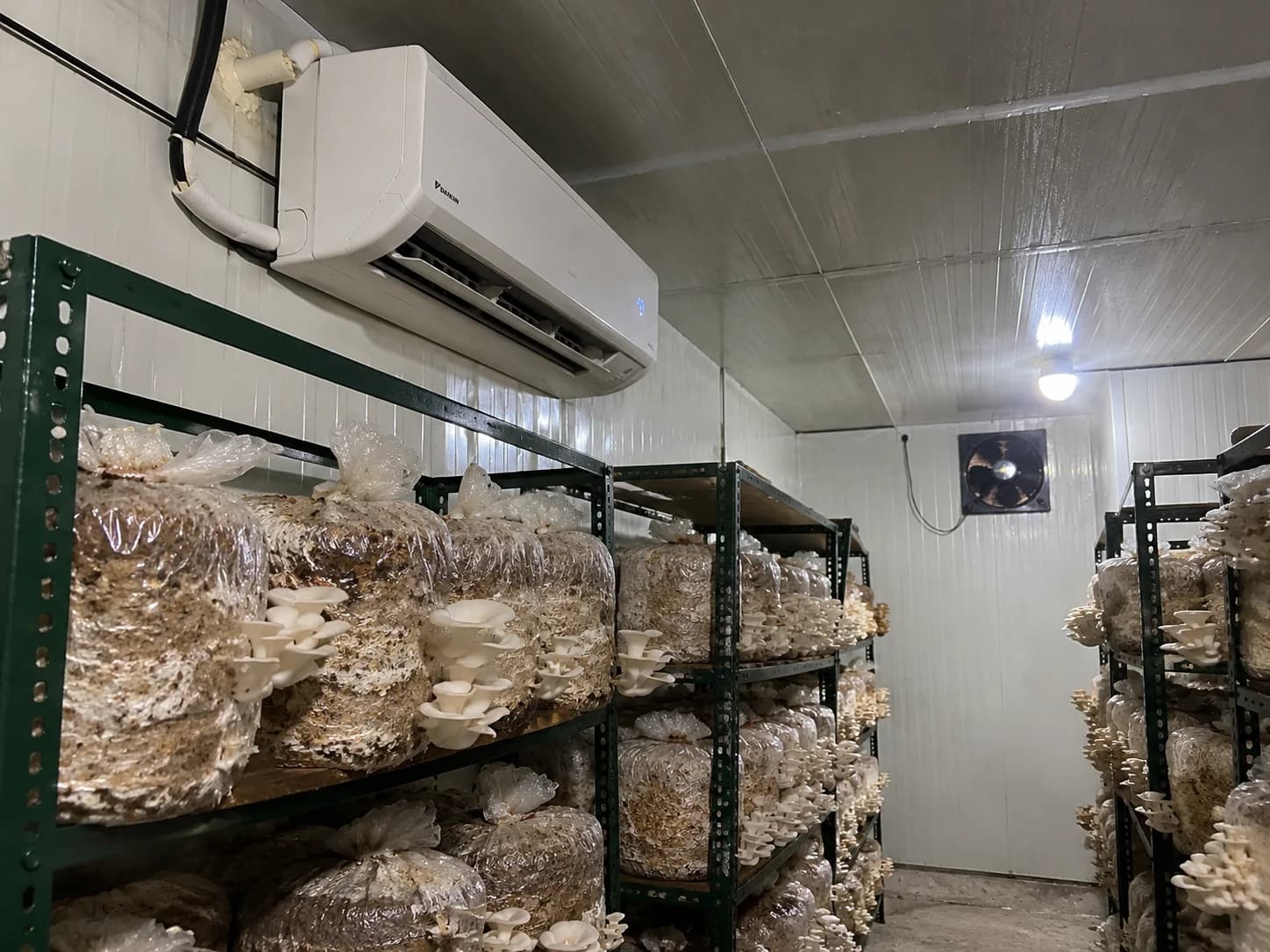
Air Conditioning for Mushroom Farming: Temperature Control Guide
Learn how air conditioning for mushroom farming works, how to choose an AC for a mushroom growing room, and manage temperature for better cultivation.
How to Grow Mushrooms at Home: A Complete Step-by-Step Guide for Beginners
Learn how to grow mushrooms at home using simple methods, mushroom spawn, straw, and grow bags. Discover humidity control, mist makers, foggers, common mistakes, and harvesting tips.