AC vs Fogger for Mushroom Farming: Which One Do You Actually Need?
If you are setting up a mushroom growing room, you will probably come across two pieces of equipment: an air conditioner (AC) and a fogger. Both are used in controlled growing environments, but they perform different jobs.
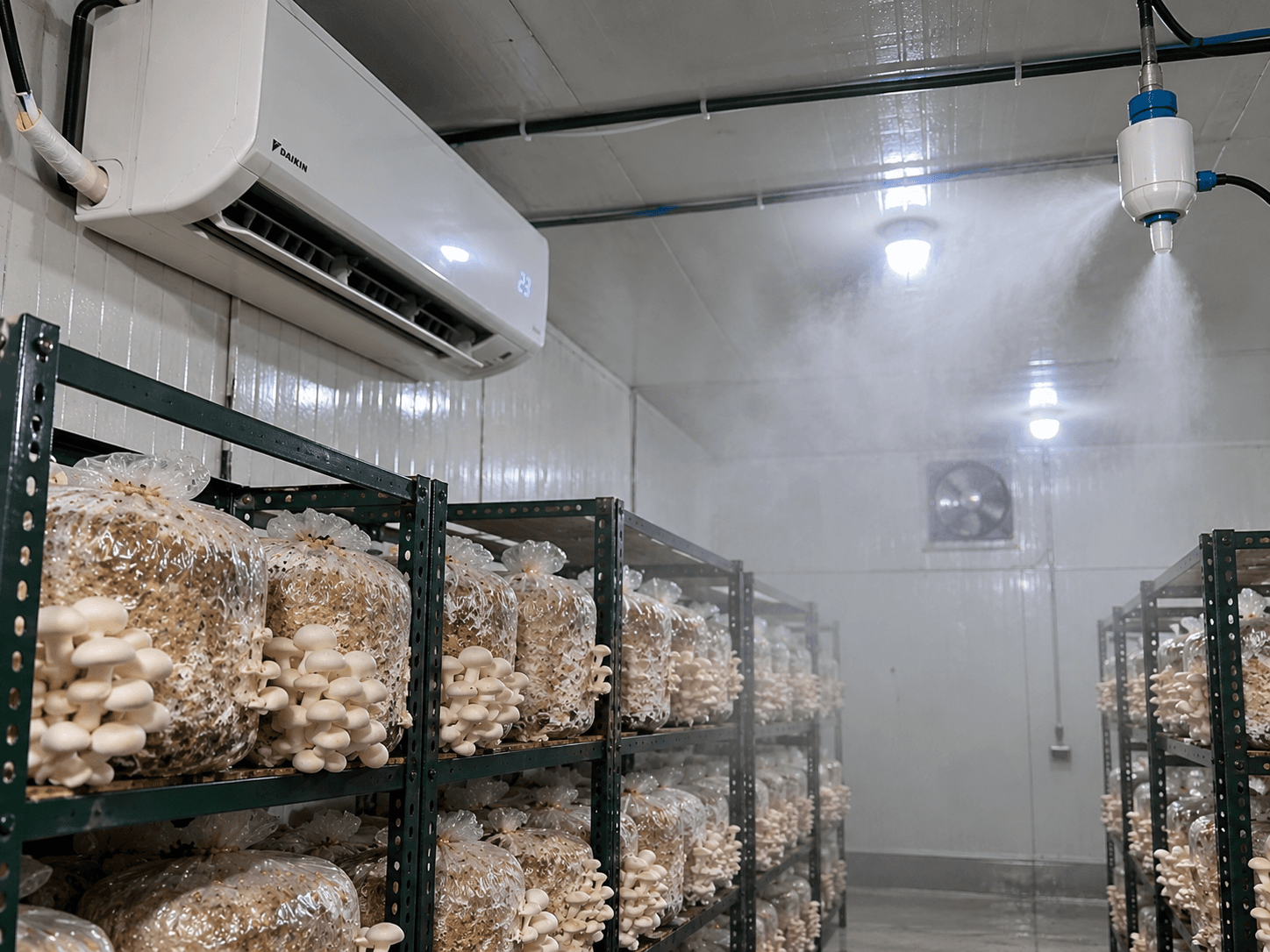
An AC primarily removes heat from a room to control temperature. A fogger produces fine water droplets that can help increase relative humidity when the surrounding air is too dry.
This difference matters in mushroom cultivation because mushrooms need suitable environmental conditions, not simply a cold room or a room filled with moisture.
For example, a grower may install an AC to manage excessive summer heat and then discover that the relative humidity drops below the desired level. Another grower may operate a fogger continuously but still struggle to maintain the required temperature.
These problems often occur because temperature control and humidity control are being treated as the same task.
The main difference between an AC and a fogger is simple: an AC is primarily used for cooling, while a fogger is primarily used for adding moisture to the air. Neither machine automatically replaces the other.
In this guide, we will compare AC vs fogger for mushroom farming, explain how each system works, examine their operating costs, and discuss when using both may be appropriate.
1. What Is an AC in Mushroom Farming?
An air conditioner is a cooling system that transfers heat from the indoor space to the outside environment.
In mushroom cultivation, an AC may be used when the growing room becomes warmer than the temperature required by the selected mushroom variety or production stage.
A properly selected system can help maintain a more stable temperature during hot weather. However, the actual result depends on cooling capacity, room insulation, ventilation, equipment heat, and the number of cultivation bags.
How Does an AC Work in a Mushroom Growing Room?
A typical split AC has an indoor unit and an outdoor unit.
The indoor unit absorbs heat from the room. The refrigerant carries that heat to the outdoor unit, where it is released outside.
This process reduces the room’s temperature when the system has sufficient capacity to handle the cooling load.
An AC can also remove moisture from the air as condensation forms on its cold evaporator coil. This is why some mushroom growers notice a reduction in relative humidity after switching on their air conditioner.
However, the amount of moisture removed depends on operating conditions, including coil temperature, airflow, indoor humidity, and compressor operation. For detailed calculations on sizing cooling units, read our guide on air conditioning for mushroom farming.
When Is an AC Useful for Mushroom Cultivation?
An AC may be useful when:
- Outdoor temperatures are too high for the intended crop.
- The growing room needs more consistent temperature control.
- The room is properly insulated and has a manageable cooling load.
- Commercial production requires environmental conditions that cannot be maintained naturally.
- Heat from cultivation bags, lighting, equipment, or incoming air needs to be managed.
A residential split AC may suit some small, appropriately designed growing rooms. Larger commercial rooms may require a professionally designed HVAC or mushroom farming chiller system as part of a turnkey commercial farm setup.
The correct equipment should be selected according to the actual cooling load rather than floor area alone.
2. What Is a Fogger in Mushroom Farming?
A fogger is a device that disperses water into fine droplets. Depending on its design, it may use ultrasonic vibration, high-pressure nozzles, or another mechanism to produce a mist.
In mushroom cultivation, fogging is commonly used to increase relative humidity when the growing environment is too dry.
This can be important during fruiting, when many cultivated mushroom varieties require relatively humid conditions to support normal development.
However, humidity requirements vary by mushroom species, strain, and growth stage. A single humidity setting should not be used for every type of mushroom.
How Does a Mushroom Fogger Work?
A fogger introduces fine droplets into the surrounding air. Some droplets evaporate, increasing the amount of water vapour in the air.
When the moisture content increases without a corresponding increase in air temperature, relative humidity generally rises.
Evaporation may also absorb heat from the surrounding environment. Under suitable conditions, this can provide some evaporative cooling.
However, a fogger is not equivalent to an air conditioner.
Its cooling effect depends on factors such as the starting humidity, air temperature, ventilation, droplet size, and evaporation rate. In already humid conditions, the cooling effect may be limited. To understand automated disc humidifiers, see our technical breakdown of ultrasonic mist makers for mushroom farming.
When Is a Fogger Useful?
A fogger may be useful when:
- Relative humidity is below the target range.
- The growing room has a suitable temperature but needs additional moisture.
- The farm needs a controlled method of increasing humidity.
- The system can distribute mist without leaving mushrooms, walls, electrical equipment, or growing surfaces excessively wet.
A fogger should be selected and operated according to the room design and crop requirements. Fine mist does not guarantee uniform humidity throughout a room.
3. AC vs Fogger: What Is the Difference?
The most important distinction is the function each machine performs.
| Feature | AC | Fogger |
|---|---|---|
| Main purpose | Removes heat from the room | Adds moisture to the air |
| Primary environmental control | Temperature | Relative humidity |
| Can increase humidity? | Not normally; cooling may cause dehumidification | Yes, when droplets evaporate |
| Can reduce temperature? | Yes, when correctly sized and operated | Sometimes, through evaporation |
| Works effectively in very humid conditions? | Depends on cooling load and equipment | Evaporative cooling may be limited |
| Main operating input | Electricity and refrigerant system | Electricity and water |
| Main maintenance concerns | Filters, coils, drainage, refrigerant system | Nozzles or transducer, water quality, deposits and sanitation |
| Replaces the other machine? | No | No |
The table illustrates why choosing between an AC and a fogger should not be based on which machine appears more powerful.
First identify the environmental problem. Then select the equipment that addresses it.
If the room is too hot, additional fogging may not solve the underlying problem. If the room is at the correct temperature but the air is too dry, running the AC harder may not be the best response.
4. Can a Fogger Replace AC in Mushroom Farming?
This is one of the most important questions for farmers trying to reduce setup costs.
The short answer is: sometimes a fogger can provide limited evaporative cooling, but it cannot reliably replace mechanical air conditioning when substantial heat removal is required.
Consider a mushroom growing room during a hot afternoon.
The room temperature is above the target range, and the grower switches on an ultrasonic fogger. The mist increases moisture in the air, and some evaporation may reduce the air temperature.
However, if the room is already highly humid, much less additional evaporation may occur. The room may become wetter without reaching the required temperature.
This creates a practical problem: the grower is adding moisture but not obtaining enough cooling.
A fogger may be sufficient in some naturally cool environments or suitable growing systems where the main requirement is humidity management. It should not be assumed to be an adequate cooling solution for every climate.
When Might a Fogger Be Enough?
A fogger may be sufficient for humidity management when:
- The room temperature is already suitable.
- The growing system does not require mechanical cooling.
- The climate and ventilation conditions support the intended cultivation method.
- Humidity can be maintained without excessive surface wetting.
When Is an AC More Appropriate?
An AC or another engineered cooling system may be necessary when:
- Summer heat pushes the room above the target temperature.
- The room needs active heat removal.
- Passive cooling methods cannot maintain the required conditions.
- Production requires more predictable temperature control.
For commercial mushroom farming, evaluate the room’s actual environmental conditions before investing in either system. Discover complete setup parameters through our commercial mushroom farming training courses.
5. Can You Use AC and Fogger Together?
Yes. In some mushroom growing rooms, an AC and a fogger can complement each other.
The AC manages heat, while the fogger helps maintain humidity when the air becomes too dry.
However, combining them requires careful control.
An AC can remove moisture as it cools. A fogger can add moisture back into the room. If both operate without coordination, they may work against each other and increase electricity or water consumption.
For example, a fogger may increase humidity near a sensor, causing the control system to stop fogging even though another part of the room remains dry. Alternatively, the AC may cool one area while mist accumulates in another.
How to Coordinate AC and Fogger Operation
A practical control strategy should include:
1. Separate temperature and humidity measurements
Use suitable sensors to monitor both air temperature and relative humidity. Place them where they represent conditions experienced by the crop, rather than directly in the AC discharge or fogger plume.
2. Establish crop-specific target ranges
Determine the required temperature and humidity for the mushroom variety and growth stage. Do not automatically use the same settings for oyster, button, and milky mushrooms.
3. Avoid excessive fogging
Use measured humidity and appropriate control logic instead of operating the fogger continuously.
4. Protect the AC from direct mist
Directly wetting the AC indoor unit, electrical components, or sensors can cause damage or unreliable measurements.
5. Maintain suitable ventilation
Mushrooms also need appropriate fresh air exchange. Temperature and humidity control must be coordinated with carbon dioxide management.
6. Monitor the room after changes
Check conditions at multiple locations and rack levels. A reading from one sensor may not represent the entire growing room.
A coordinated system can improve environmental stability, but its effectiveness depends on room design, sensor placement, and correct equipment sizing.
6. AC vs Fogger for Oyster Mushroom Farming
Oyster mushrooms are cultivated using different species and strains, each with its own environmental requirements.
For some oyster mushroom growing systems, a fogger is used to maintain humidity during fruiting. In warmer conditions, cooling may also be necessary.
The decision depends on the actual temperature and humidity inside the room. For home growers, our complete guide on how to grow mushrooms at home provides practical bedroom and balcony growing setups.
Example 1: Temperature Is Suitable, but Humidity Is Low
Suppose the room temperature is within the target range for the selected oyster mushroom strain, but relative humidity is lower than required. In this situation, controlled fogging may address the immediate problem. Installing a larger AC would not necessarily help. Depending on operating conditions, it could remove additional moisture from the air.
Example 2: Temperature and Humidity Are Both Too High
Suppose the room is hot and humid. Adding more mist is unlikely to solve the temperature problem and may make moisture management more difficult. The grower should evaluate heat removal, fresh air exchange, insulation, and the cooling load.
Example 3: Temperature Is Too High, but Humidity Is Suitable
In this case, additional fogging may be unnecessary. A suitable cooling system, improved insulation, or another appropriate heat-management strategy may be more useful.
The key is to diagnose the environmental problem rather than operate every machine continuously. Ensure you use certified genetics by ordering verified oyster mushroom spawn seeds.
7. AC vs Fogger for Button Mushroom Farming
Button mushroom cultivation has specific environmental requirements that change during different production stages.
Compost colonisation, casing management, and fruiting should not all be treated as if they require identical conditions.
Temperature management is particularly important when moving the crop between production stages. Humidity must also be managed carefully, but excessive moisture on the crop or growing surfaces should be avoided. Learn correct cutting and harvesting techniques in our guide on how to cut button mushrooms.
Why Is Temperature Control Important?
Button mushroom production may require controlled cooling during the transition to fruiting and during subsequent crop management.
The actual temperature requirements depend on the production system, strain, and stage of development.
If the room is too warm, a fogger alone may not provide sufficient cooling.
Why Is Humidity Control Important?
Humidity affects the moisture balance of the growing environment. However, maintaining high relative humidity does not mean that the mushrooms should remain continuously wet.
Poorly managed fogging can create excessive surface moisture or condensation, particularly when airflow is inadequate or cold surfaces are present.
For button mushroom cultivation, the cooling and humidification systems should be planned around the complete growing process.
8. AC vs Fogger Electricity Cost: Which Is Cheaper?
Many mushroom farmers compare AC and fogger operating costs before setting up a growing room.
A fogger may consume less electricity than a large AC, but the comparison is not straightforward because the machines perform different jobs.
An AC removes heat from the room. A fogger adds moisture and may provide some evaporative cooling under suitable conditions.
If a fogger cannot maintain the required temperature, its lower electricity consumption does not make it a substitute for the cooling system that the crop actually needs.
How to Calculate Electricity Cost
Use this basic formula:
Electricity consumption (kWh) = Average electrical input (kW) × Operating hours
Operating cost = Electricity consumption (kWh) × Electricity tariff per kWh
For example, if a fogger uses an average of 0.1 kW and operates for 8 hours:
0.1 kW × 8 hours = 0.8 kWh.
If an AC averages 1.0 kW of electrical input during the same 8-hour period:
1.0 kW × 8 hours = 8 kWh.
These are illustrative calculations, not specifications for every fogger or AC. Actual electricity consumption varies by model, operating conditions, and control settings.
For a meaningful comparison, use the rated or measured electrical input of your actual equipment.
Also consider water consumption, maintenance, room insulation, cooling demand, and the cost of maintaining suitable cultivation conditions. Explore our commercial mushroom farming equipment catalog to compare hardware efficiency.
9. Why Does Humidity Drop When You Switch on the AC?
A common problem in mushroom cultivation is that the AC maintains temperature but relative humidity falls.
This happens because relative humidity depends on both the amount of water vapour in the air and the air temperature.
When an AC cools air, it may also remove moisture through condensation. As a result, relative humidity can change during operation.
The effect depends on the system and room conditions.
What Should You Check?
Before increasing fogger output, investigate:
- Whether the AC is removing substantial moisture.
- Whether outside air is entering the room.
- Whether the room has air leakage.
- Whether humidity sensors are correctly positioned.
- Whether the fogger is distributing mist evenly.
- Whether the room has cold surfaces where condensation forms.
If additional humidity is required, a controlled humidification system may help. However, excessive misting can create its own problems.
The goal is to maintain the appropriate moisture conditions without creating standing water, persistent surface wetness, or condensation-related issues.
10. Common Mistakes When Using AC and Fogger Together
Mistake 1: Running the Fogger Continuously
Continuous fogging can push humidity above the required range and wet nearby surfaces. Use suitable sensors and control logic to match output to demand.
Mistake 2: Directing Mist Toward the AC
Mist entering the AC unit may cause moisture-related problems and can interfere with equipment operation. Position the fogger so that mist is distributed appropriately without directly wetting electrical equipment.
Mistake 3: Ignoring Carbon Dioxide
A room may have the correct temperature and humidity but still have unsuitable carbon dioxide levels. Fresh air exchange should be designed according to the crop’s requirements.
Mistake 4: Using One Sensor for the Entire Room
Temperature and humidity may vary across racks and room sections. Measure conditions at representative crop locations and investigate significant differences.
Mistake 5: Choosing AC Capacity by Floor Area Alone
The required cooling capacity depends on insulation, outdoor conditions, ventilation, equipment heat, and the biological heat load. A cooling-load calculation is more reliable than copying another farm’s AC size.
Mistake 6: Ignoring Water Quality and Cleaning
Foggers can accumulate mineral deposits or biological contamination if water quality and maintenance are neglected. Follow the equipment manufacturer’s instructions for water quality, cleaning, and sanitation.
Mistake 7: Confusing High Humidity with Wet Mushrooms
High relative humidity does not mean that mushrooms should remain covered in water droplets. Maintain appropriate humidity and airflow while avoiding excessive surface wetness.
11. What Is the Best Setup for a Mushroom Growing Room?
There is no universal combination of AC and fogger that works for every mushroom farm.
The most appropriate setup depends on the mushroom variety, growing method, local climate, room construction, and production target.
A small seasonal growing room may need only basic environmental management. A commercial room operating during hot weather may require mechanical cooling, controlled humidification, insulation, and ventilation.
Before choosing equipment, evaluate the following:
| Requirement | What to assess |
|---|---|
| Temperature | Crop-specific target range and outdoor design conditions |
| Humidity | Required relative humidity and current room readings |
| Room insulation | Heat entering through walls, roof, doors, and gaps |
| Cooling load | Room size, equipment heat, ventilation, and biological heat |
| Water supply | Quality and availability for the humidification system |
| Air circulation | Distribution across racks and growing surfaces |
| Fresh air | Carbon dioxide management and crop requirements |
| Electrical cost | Expected consumption of all equipment |
| Maintenance | Cleaning, drainage, sensors, filters, and fogger components |
| Automation | Whether temperature and humidity controls can coordinate equipment |
This assessment helps determine whether the room needs an AC, a fogger, both systems, or a different environmental-control arrangement.
12. Frequently Asked Questions About AC vs Fogger
Is AC or fogger better for mushroom farming?
Neither is universally better. An AC is primarily used to remove heat, while a fogger is primarily used to increase humidity. Choose according to the environmental condition that needs correction.
Can a fogger cool a mushroom room?
A fogger may provide evaporative cooling when droplets evaporate, but the effect depends on temperature, humidity, ventilation, and droplet characteristics. It cannot reliably replace AC where substantial mechanical cooling is needed.
Can I run AC and fogger together?
Yes, when both systems are suitable for the growing room and their operation is coordinated. Monitor temperature and humidity, prevent direct mist exposure to equipment, and maintain suitable ventilation.
Does an AC reduce humidity in mushroom farming?
An AC can remove moisture through condensation. The effect depends on the operating conditions, so monitor relative humidity instead of assuming it will always fall by the same amount.
Which fogger is suitable for mushroom cultivation?
The choice depends on room size, water quality, required humidity, droplet characteristics, ventilation, and maintenance requirements. The system should distribute moisture appropriately without creating excessive wetness.
Is a fogger necessary if my mushroom room has an AC?
Not always. If humidity remains within the required range, additional humidification may not be necessary. If the AC lowers humidity below the target, a suitable controlled humidification system may help.
Can I grow mushrooms without an AC?
Yes, some mushroom farms can maintain suitable conditions through seasonal production, insulation, ventilation, and other environmental-management methods. Mechanical cooling may be necessary when the local climate exceeds the crop’s temperature requirements.
Which uses less electricity: AC or fogger?
A fogger often has a lower electrical load than an AC, but actual consumption depends on the equipment. They perform different functions, so compare their energy use only after determining what environmental control the crop needs.
Conclusion: AC vs Fogger in Mushroom Farming
The choice between an AC and a fogger should begin with one question: What is wrong with the growing-room environment—temperature, humidity, or both?
If the room is too hot, an appropriately sized AC or another suitable cooling system may be required.
If the temperature is suitable but the air is too dry, controlled fogging may help maintain humidity.
If both temperature and humidity need management, an AC and a fogger may work together when their operation is properly coordinated.
For commercial mushroom cultivation, temperature, humidity, ventilation, carbon dioxide, and sanitation must be considered as parts of the same growing environment.
Buying more equipment does not automatically produce better results. Understanding the crop’s requirements, measuring actual room conditions, and choosing equipment based on those measurements is a more reliable approach.
The best mushroom growing room is not simply the coldest or the most humid room. It is the room that maintains the appropriate environmental conditions for the selected mushroom variety and production stage.
Plan Your Commercial Mushroom Climate Control System
Need expert sizing for mushroom room AC tonnage, ultrasonic mist makers, or complete turnkey climate automation? Our agricultural engineering team provides end-to-end guidance.
Recommended Mushroom Cultivation & Setup Guides
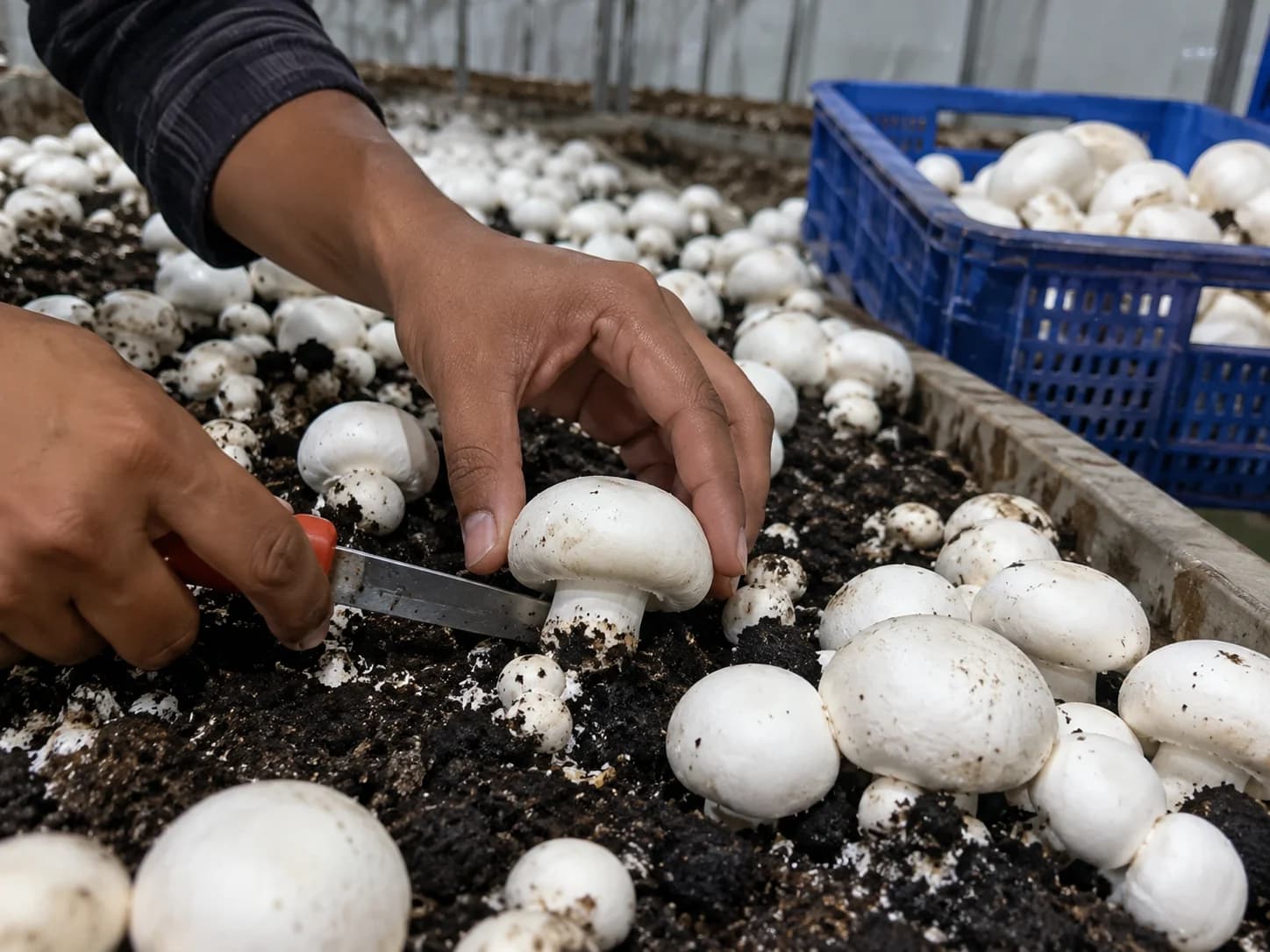
How to Cut Button Mushrooms: The Right Harvesting Method for Better Quality
Learn how to harvest button mushrooms correctly: should you cut with a knife or twist by hand? Complete stem trimming guide, tools, timing, flush care, and commercial quality tips.
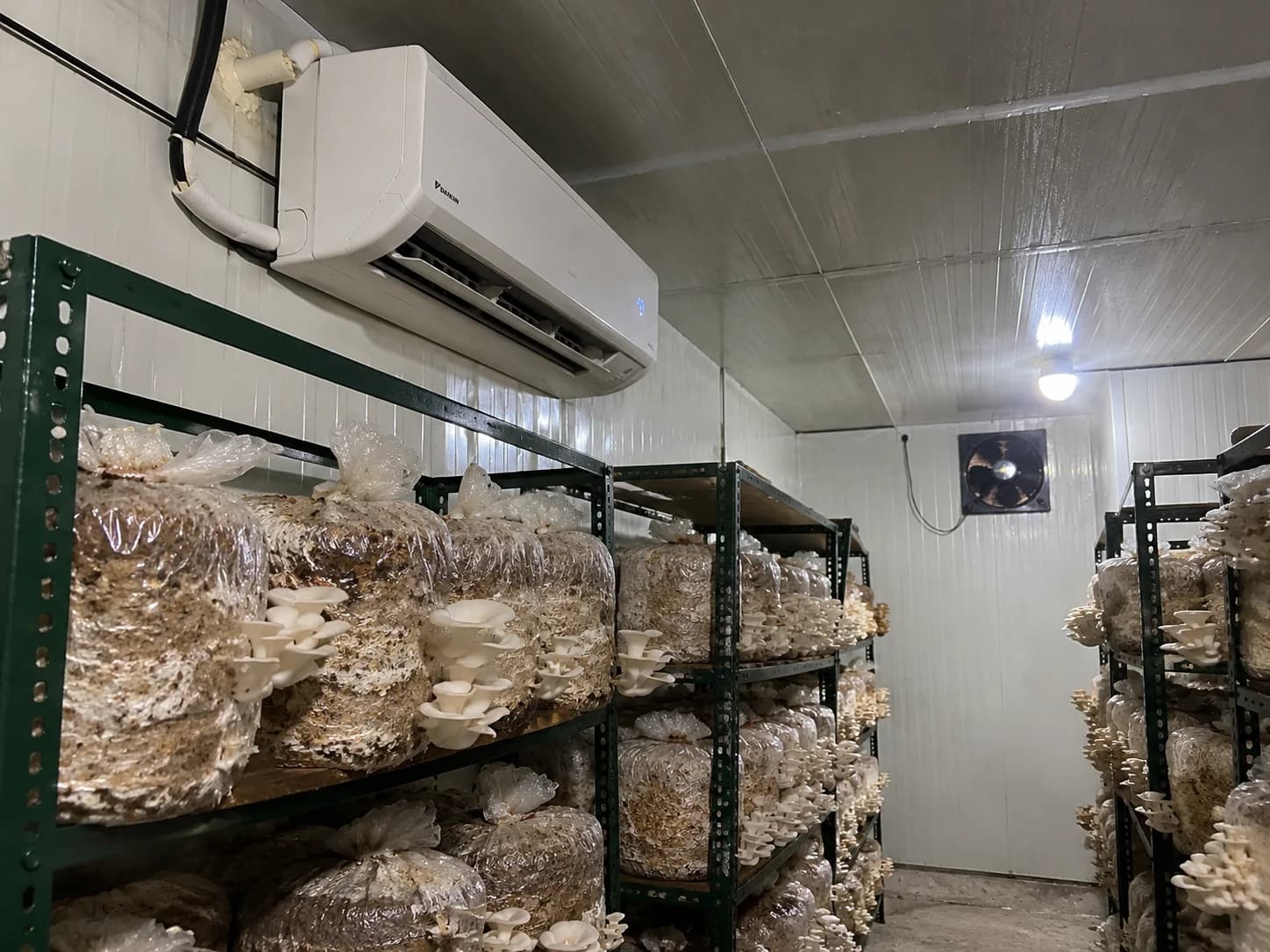
Air Conditioning for Mushroom Farming: Temperature Control Guide
Learn how air conditioning for mushroom farming works, how to choose an AC for a mushroom growing room, and manage temperature for better cultivation.
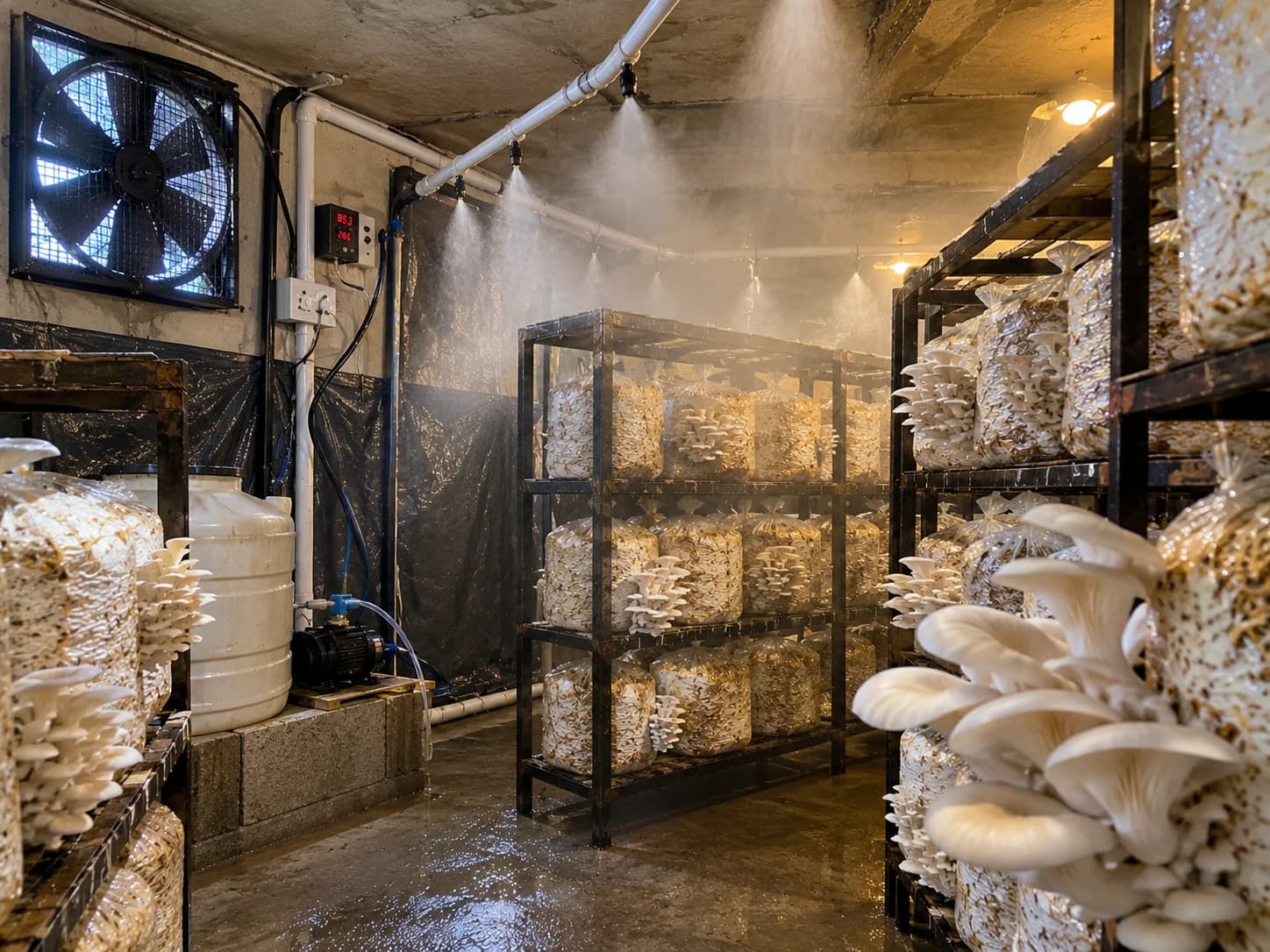
How to Grow Mushrooms at Home: A Complete Step-by-Step Guide for Beginners
Learn how to grow mushrooms at home using simple methods, mushroom spawn, straw, and grow bags. Discover humidity control, mist makers, foggers, common mistakes, and harvesting tips.
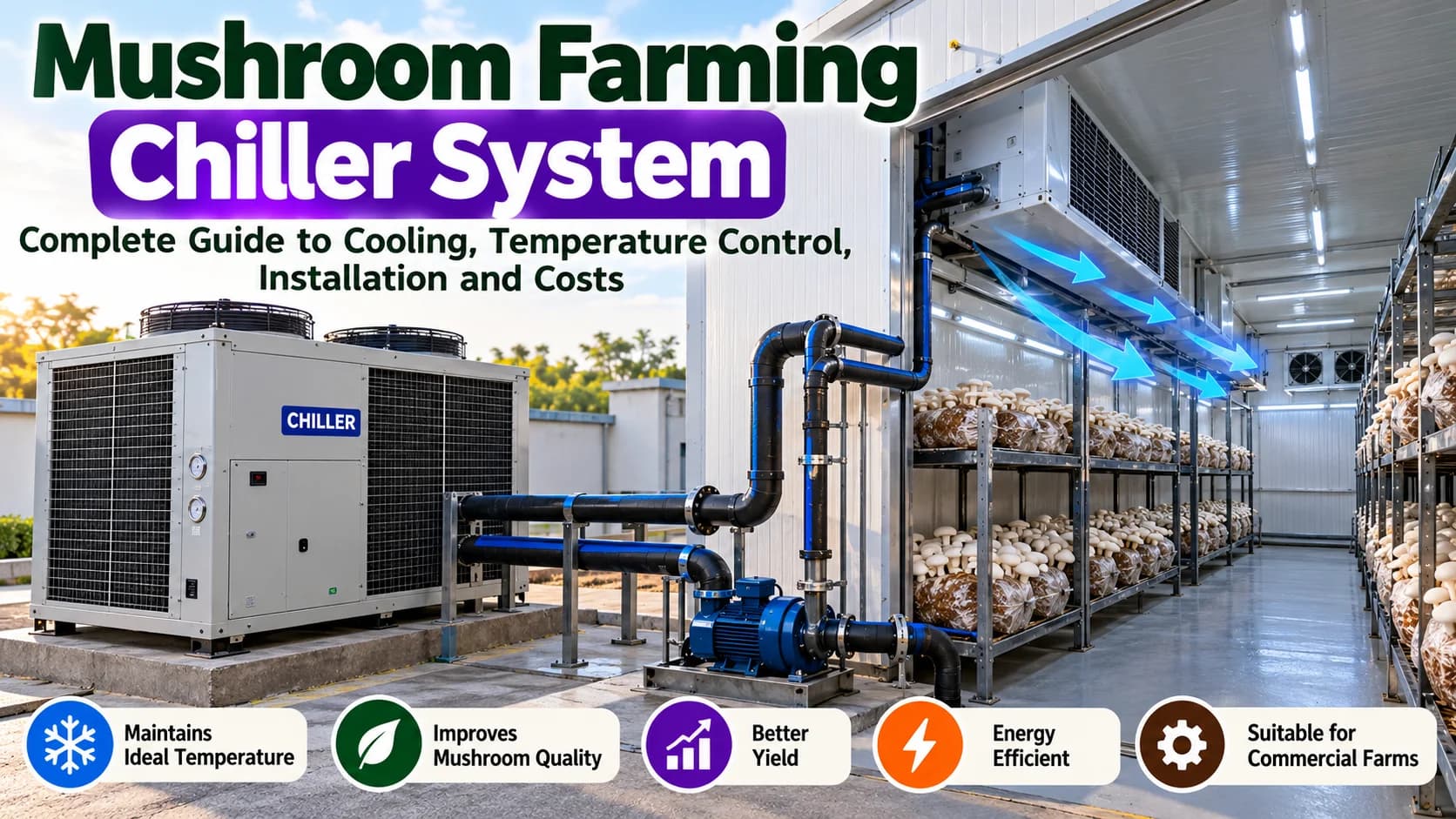
Mushroom Farming Chiller System: Complete Guide to Cooling, Temperature Control, Installation and Costs
Complete technical guide to mushroom farming chillers: air-cooled vs water-cooled, cooling load calculations, button mushroom temperature control, electricity consumption, and setup costs.