How to Actually Control Temperature in Indian Mushroom Farms
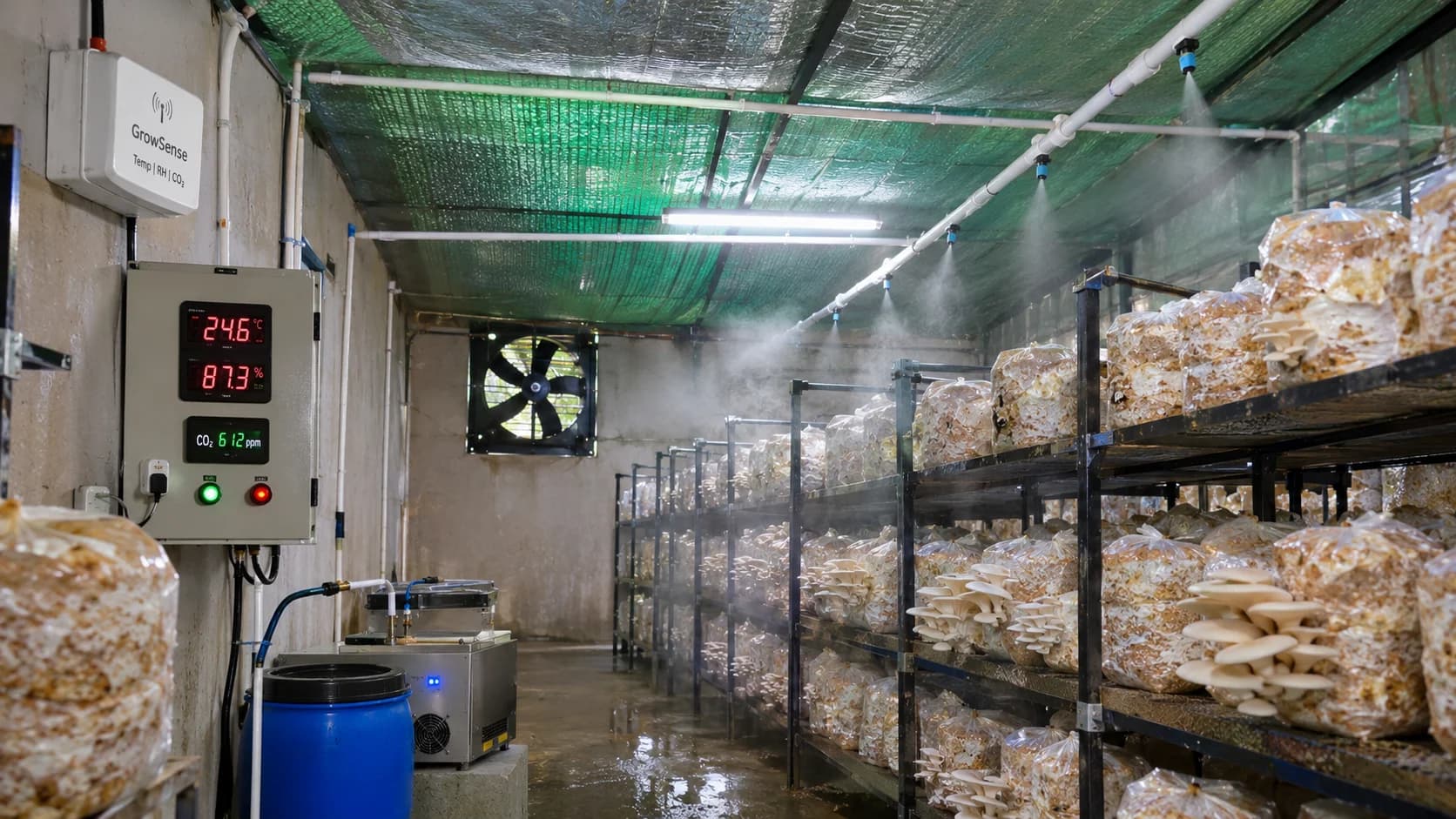
Anyone can buy good spawn and boil wheat straw. The real test of a mushroom grower happens at 2:00 PM on a hot afternoon when the outside temperature hits 38°C, your growing room starts feeling like an oven, and your pins suddenly turn yellow and shrivel up before your eyes.
Most beginners make one expensive mistake: they look at the room thermometer, see the temperature rising, and start spraying cold water directly onto the bags. Within 48 hours, that standing water combined with trapped heat invites bacterial blotch, cobweb mold, and green Trichoderma.
Controlling temperature in a mushroom farm isn’t about buying the most expensive AC. It is about stopping external heat from entering your room first, and then balancing three things that always fight each other: Temperature, Relative Humidity (RH), and Fresh Air Exchange (CO2).
Here is the exact field-tested blueprint—from zero-electricity desi hacks for small sheds to automated sensor loops for commercial rooms—to keep your farm at the exact degree your mushrooms demand.
1. Know Your Exact Numbers First (Spawn Run vs. Cropping)
Before adjusting your room, stop treating your farm like it needs one fixed temperature. Every variety has two distinct phases, and the bag’s internal temperature is always 2°C to 3°C higher than your room air because running mycelium generates its own metabolic heat (thermogenesis).
| Mushroom Variety | Spawn Run (Vegetative Phase) | Pinning & Cropping (Fruiting Phase) | Ideal Humidity (RH) |
|---|---|---|---|
| Oyster (Dhingri) | 24°C – 28°C | 18°C – 24°C (Depends on strain) | 80% – 90% |
| Button (Agaricus) | 23°C – 25°C (Case Run) | 15°C – 18°C (Strict shock needed) | 85% – 90% |
| Milky (Calocybe) | 28°C – 32°C | 30°C – 35°C (Loves Indian summers) | 85% – 90% |
| Lion’s Mane / Shiitake | 22°C – 25°C | 16°C – 20°C | 80% – 85% |
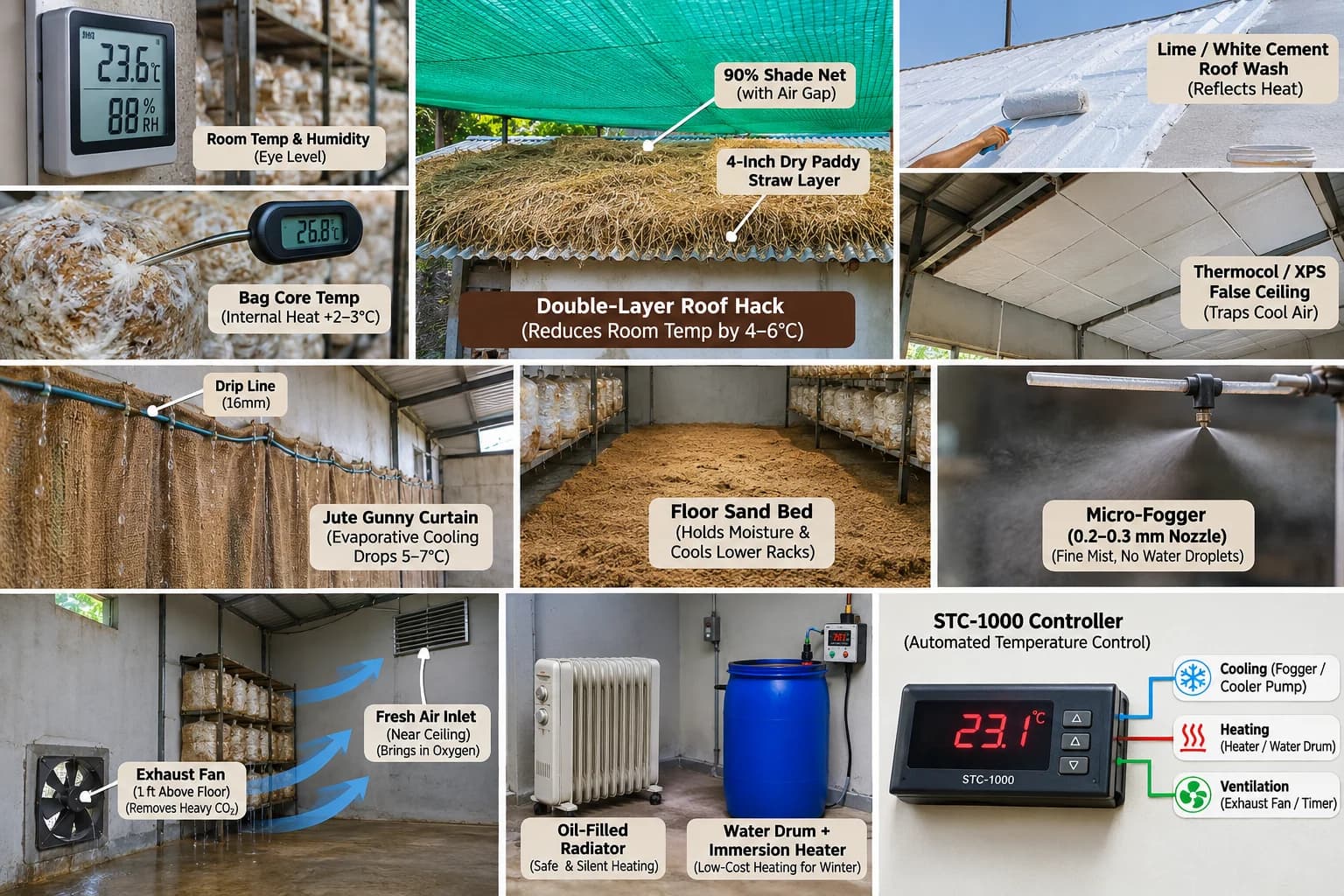
Field Rule: Never rely on a single wall thermometer hung near the door. Hang two digital hygrometers—one at eye level in the center rack, and one near the bottom rack—and keep a probe thermometer poked inside one sample substrate bag to monitor core bag heat during the first 12 days.
2. Stop Heat at the Roof (80% of Your Cooling Battle)
If you are growing inside a brick room with a concrete slab (lanter), an asbestos sheet, or a tin shed, your ceiling is acting like a giant radiator. You can run a cooling system all day, and the roof will defeat it by noon. Fix the structure before spending money on electricity:
The Double-Layer Roof Hack (For Sheds & Top Floors): Spread a 4-inch layer of dry paddy straw (parali), thatch, or old gunny bags directly on top of your roof. Above that, stretch a 90% UV-stabilized green shade net with a 1-foot air gap. This simple air gap drops the indoor room temperature by 4°C to 6°C without spending a single rupee on power.
Lime + White Cement Roof Wash: Paint the top of your concrete roof and outer walls (especially the West and South-facing walls) with white solar-reflective lime wash or white cement mixed with Fevicol.
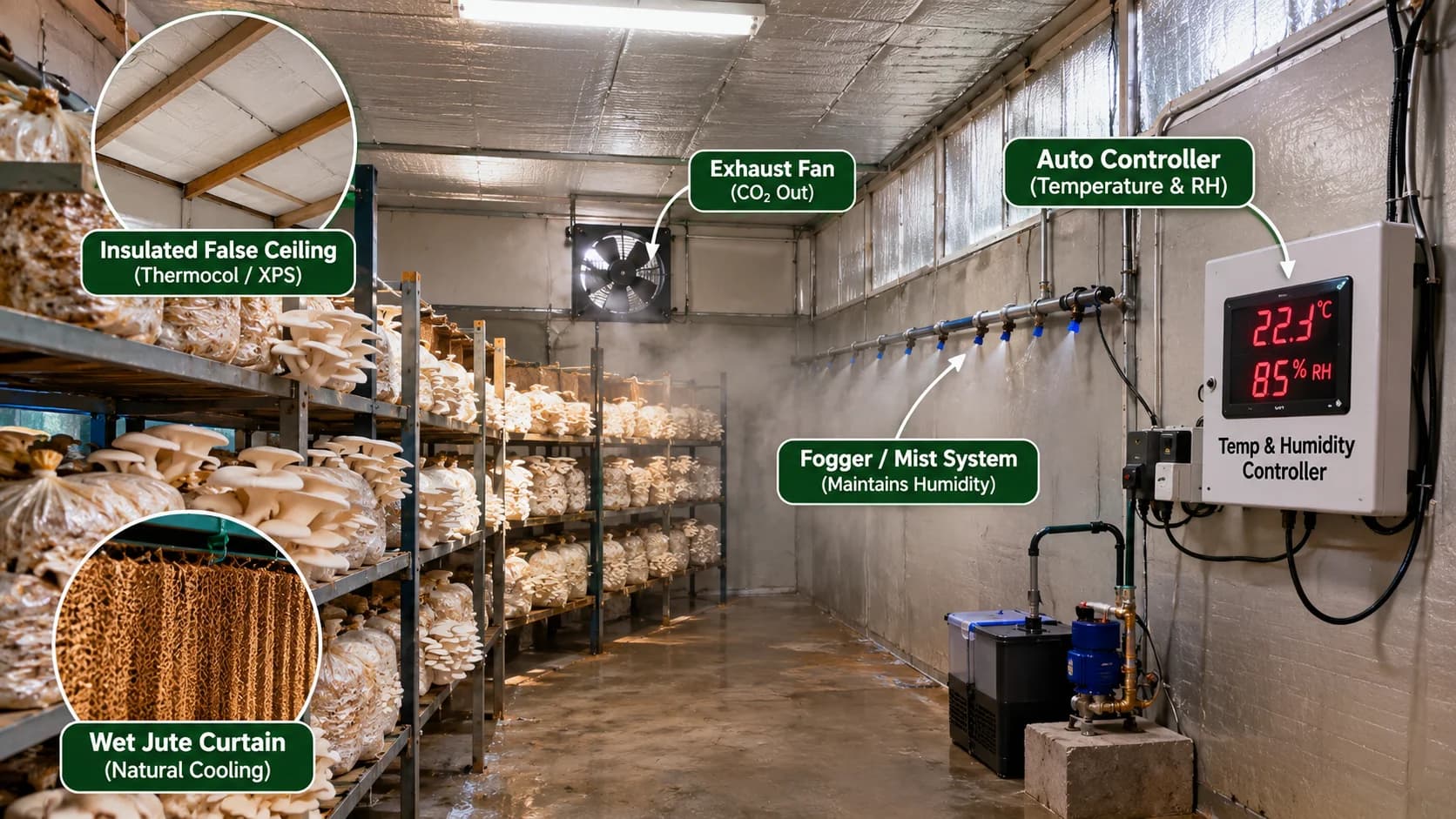
Thermocol / XPS False Ceiling: If you have a tin or asbestos roof, install 1-inch high-density thermocol sheets underneath the rafters and seal the joints with aluminum tape. It traps your cold air in a smaller volume and stops hot roof radiation immediately.
3. Low-Budget Evaporative Cooling (For Oyster & Milky Growers)
If you are growing Oyster or Milky mushrooms in a 10x10 or 15x20 room, installing an air conditioner will destroy your per-kg profit margin. Instead, use evaporative cooling—turning water evaporation into a natural temperature drop:
Jute Gunny Curtains on Walls & Windows: Hang thick, double-layered jute gunny sacks (bori) along the inside walls (leaving a 6-inch gap from the bags) and across all air inlets. Run a 16mm drip irrigation lateral line along the top of the jute curtain. When you run water through the drip for 10 minutes at 11:00 AM and 2:00 PM, incoming hot air passes through the wet jute and cools down by 5°C to 7°C while naturally boosting room humidity.
Floor Sand Bed (Reti Method): Spread a 2-inch layer of clean river sand on your brick/cement floor. Wet the sand once in the morning. Unlike bare concrete that dries in 20 minutes, wet sand holds moisture all day and cools the lower racks through slow evaporation—without leaving stagnant puddles that breed mosquitoes and sciara flies.
4-Nozzle Fogger + Exhaust Synchronization: Never use big water sprinklers inside a fruiting room; heavy water droplets sitting on mushroom caps cause yellowing and rot. Install a 0.2mm or 0.3mm micro-fogger kit paired with a small high-pressure diaphragm pump. It creates a fine smoke-like mist that flashes into vapor in mid-air, absorbing room heat instantly.
4. The Biggest Trap: How to Cool the Room Without Suffocating Your Mushrooms
Here is a problem every grower faces at least once: To keep the room cool, you shut all the doors and windows—and within 24 hours, your Oyster mushrooms grow long, thick stems with tiny caps, or your Button pins abort completely.
Why? Because mushrooms breathe oxygen and exhale massive amounts of Carbon Dioxide (CO2). When you seal the room to save cooling, CO2 shoots past 2,000 PPM, suffocating the crop.
To fix this without losing your cool temperature, use the Early Morning Thermal Flush:
Exhaust at the Bottom, Inlet at the Top: CO2 is heavier than oxygen and settles near the floor. Install your exhaust fan 1 foot above floor level, and keep your filtered fresh air inlet near the ceiling on the opposite wall.
Run Heavy Ventilation at 4:00 AM – 6:00 AM: In almost every part of India, ambient air is coolest right before sunrise. Program a ₹400 digital cyclic timer on your exhaust fan to flush out trapped CO2 for 20 minutes at 5:00 AM, pulling in naturally cool outside air for free. During peak afternoon heat (1:00 PM to 4:00 PM), run the exhaust in short 3-minute bursts every 2 hours through a wet honeycomb cooling pad.
5. Winter Heating & Commercial Automation (Scaling Up Safely)
What happens in December and January when night temperatures drop to 6°C in North and Central India, and your Oyster mycelium goes completely dormant?
Never Use Open Coil Heaters or Blower Heaters: Red-hot coil blowers burn up room oxygen and drop your relative humidity from 85% to 35% in an hour, cracking the caps of your mushrooms.
The Oil-Filled Radiator (OFR) or Water Drum Hack: For medium rooms, an Oil-Filled Room Heater provides gentle radiant heat without drying the air. For a low-cost alternative, place a 100-liter plastic drum of water inside the room with a standard 1500W immersion water heater rod hooked to a temperature controller. Warm water radiates steady heat and releases gentle steam.
STC-1000 / W1209 Temperature Controller Setup (Under ₹500): Stop turning foggers, coolers, and heaters on and off by hand. Wire a simple STC-1000 digital thermostat to your cooling pump and heater. Set your target range (for example, 20°C to 23°C)—the sensor automatically triggers your fogger/cooler the second the room hits 23.1°C and cuts power the moment it drops back to 20°C.
Frequently Asked Questions (FAQs)
Q: Why are my Oyster mushrooms growing long stems with very small caps?
Long stems and tiny caps (often shaped like trumpets) are caused by high Carbon Dioxide (CO2) levels, not just temperature. It happens when growers seal the room tightly to maintain cooling or humidity. Run an exhaust fan positioned near the floor for 10–15 minutes every 3 to 4 hours to bring CO2 below 800 PPM.
Q: Can I use a normal desert air cooler inside an Oyster mushroom room?
Yes, a desert cooler with honeycomb pads works well for 10x10 or 15x20 rooms during dry summer heat (April–June). However, keep the cooler outside the room window so it pushes fresh, cooled air inside, and cover the front grill with a fine nylon mesh to prevent fruit flies (Phorid and Sciarid flies) from entering your bags.