Why Mushroom Bags Turn Green: The Real Causes of Trichoderma Mold and How to Stop It on Your Farm
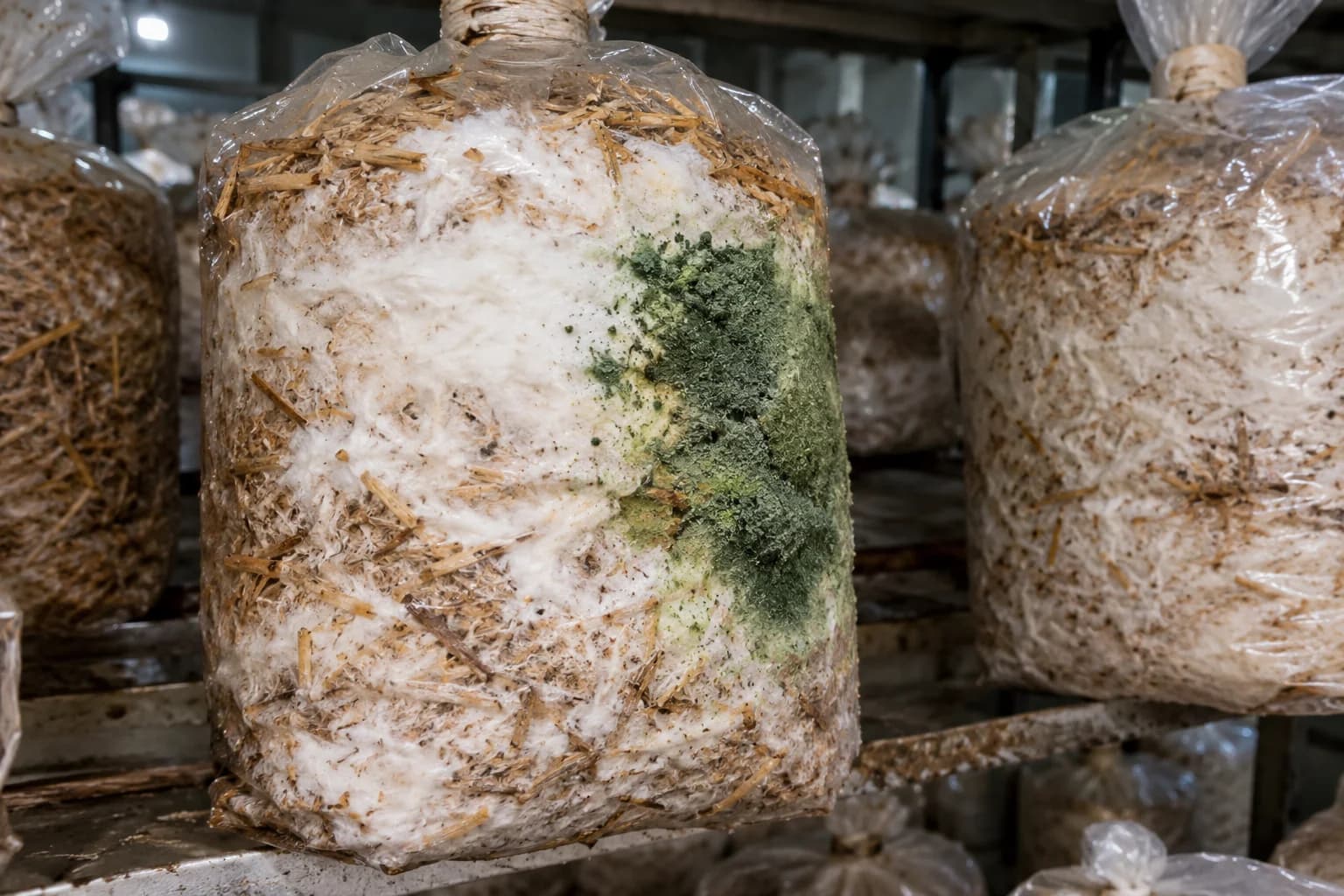
Walking into your dark incubation room in the morning, there is nothing better than seeing thick, cottony-white mycelium racing through your straw substrate. And there is nothing more frustrating than flipping a bag over and spotting an ugly, dusty green patch staring back at you.
Every grower—whether running a small home setup or managing thousands of commercial bags—eventually asks the same question: "Why do mushroom bags turn green even when I followed every hygiene step?"
Having dealt with hundreds of batches on the farm, I can tell you one thing with certainty: green mold rarely happens by bad luck. It almost always traces back to a tiny mistake made during substrate preparation, spawning, or the first seven days of incubation. Here is a practical, field-tested breakdown of what that green mold actually is, why it shows up in your bags, and how to lock it out of your next batch.
What Is the Green Stuff Inside Your Mushroom Bag?
In more than 95% of cases, the green patches inside mushroom grow bags are Trichoderma (most commonly Trichoderma harzianum or Trichoderma viride). Occasionally, you might also see Penicillium or Aspergillus, which tend to look slightly more blue-green or dark olive.
Here is the catch that tricks most beginners: Trichoderma does not start out green.
For the first two to three days, Trichoderma mycelium is bright, aggressive white. In fact, it often looks whiter and faster-growing than your actual Oyster or Button mushroom mycelium. Many new growers look at a patch of Trichoderma on day four and think, "Wow, my spawn run is moving fast!" Then, within 24 hours, the fungus matures, releases millions of spores, and turns into a dense green powder.
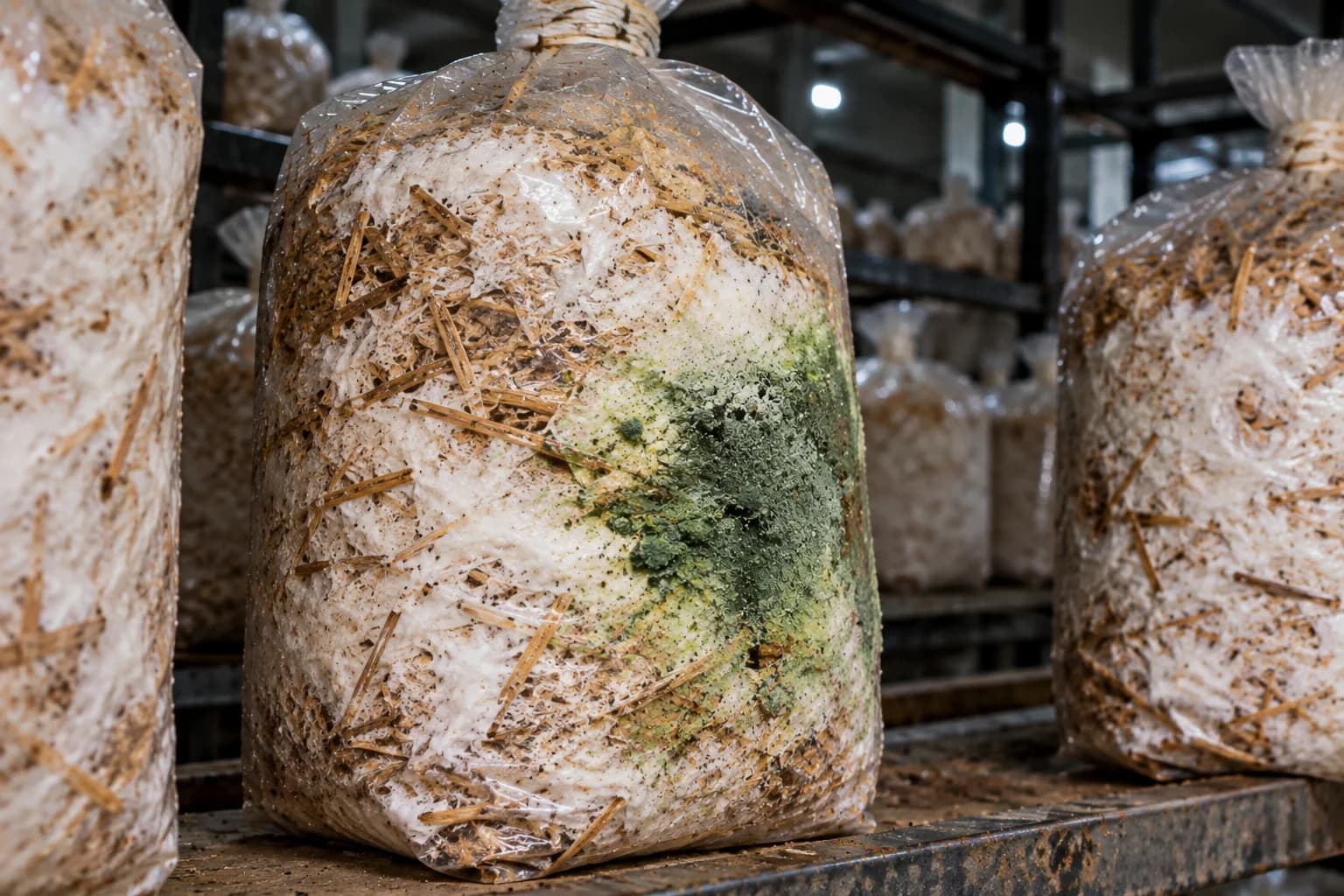
Why Mushroom Bags Turn Green During Spawn Run: 5 Real Farm Causes
Whenever green mold hits a batch, the root cause usually lies in one of these five areas:
1. Excess Moisture Pooled at the Bottom of the Bag
Stagnant water is Trichoderma’s best friend. When straw or sawdust holds too much free water, the tiny air pockets between the fibers fill up with liquid.
What happens inside: Mushroom mycelium needs oxygen to breathe. Where water pools—especially at the bottom corners of the polythene bag—the environment turns anaerobic (oxygen-starved). Your mushroom mycelium stalls out, sour bacteria move in, and Trichoderma takes over the wet, suffocated straw.
The Farm "Fist Test" (Squeeze Test): Before bagging your pasteurized substrate, grab a tight handful and squeeze it as hard as you can. Your palm should feel damp, and at most one or two drops of water should appear between your fingers. If water streams out, your moisture is above 70%—spread it out to drain before spawning.
2. Pasteurization Temperature Mistakes (Boiling vs. Pasteurizing)
A common myth in mushroom cultivation is that hotter is always better. Many growers boil their straw at 100°C thinking it will kill every contaminant. In standard steam or hot-water pasteurization, overheating actually invites green mold.
The Sweet Spot (65°C to 70°C): Proper pasteurization holds the substrate between 65°C and 70°C for 60 to 90 minutes. This temperature kills harmful fungal spores while keeping beneficial thermophilic (heat-loving) bacteria alive. Those good microbes act as natural bodyguards for your mushroom mycelium during spawn run.
The Danger of Over-Boiling: If you boil straw at 95°C–100°C without sterile lab conditions, you wipe out the beneficial microbes and break down tough hemicellulose into simple sugars. Once you open that bag in normal room air, floating Trichoderma spores land on an unguarded buffet of free sugar and explode across the bag.
3. Weak, Old, or Pre-Contaminated Mushroom Spawn
Sometimes your substrate moisture and pasteurization are spot-on, yet green dots appear specifically on top of individual grain kernels throughout the bag within 3 to 5 days of spawning.
What it means: If the green mold is centered directly on every wheat or sorghum grain, the contamination came from the spawn, not your straw.
Why it happens: Even if a spawn packet looks white in the bag, spawn that has been stored too long, exposed to high heat during transit, or slightly contaminated with bacteria ("wet spot") loses its vigor. When mixed into wet straw, weak mycelium cannot defend the starch inside the grain, and Trichoderma immediately feeds on the exposed grain kernel.
4. Low Substrate pH (Skipping or Under-Dosing Hydrated Lime)
Trichoderma thrives in acidic to neutral conditions (pH 4.5 to 6.0), whereas Oyster and Milky mushroom mycelium can comfortably grow in a more alkaline environment. If your water or straw is naturally acidic and you don't buffer it properly with Hydrated Lime (Calcium Hydroxide - Ca(OH)₂), the pH drops rapidly during incubation, giving green mold a massive head start.
5. Internal Bag Overheating Above 28°C
This is the silent killer of commercial batches. You might look at your room thermometer, see 26°C, and assume your bags are safe.
The Metabolic Heat Factor: As mycelium digests straw, it generates its own internal heat (thermogenesis). The core temperature inside a 10 kg mushroom bag is typically 3°C to 4°C hotter than the room air.
If your room is at 26°C, the center of your bag is easily hitting 29°C to 30°C. Above 28°C, mushroom mycelium slows down dramatically, while Trichoderma hits its peak growth speed.
📊 Quick Diagnostic Table: Find Out Where the Contamination Started
You can tell exactly what went wrong in your process just by looking at where the green mold appears in the bag:
| Where the Green Mold Appears | Most Likely Cause | Immediate Fix for Your Next Batch |
|---|---|---|
| Directly on top of individual spawn grains | Old, overheated, or contaminated spawn | Switch to fresh, vigorous spawn; check for sour odors before use |
| Only at the bottom corners of the bag | Excess water pooling in the substrate | Drain substrate longer; pass the "Fist Squeeze Test" (60–65% moisture) |
| Around the pin-holes or bag tie neck | Dirty room air or Mushroom Flies (Sciarid/Phorid) | Install fine mesh screens, use yellow sticky traps, sanitize room air |
| Large patches scattered all over the bag | Improper pasteurization or low substrate pH | Maintain 65°C–70°C pasteurization and adjust substrate pH to 7.5–8.2 |
| In the center core of tightly stacked bags | Internal overheating (Metabolic heat > 28°C) | Leave 2–3 inches of airflow space between bags on the racks |
Can You Save a Mushroom Bag With Green Mold? (The Honest Truth)
If you search online, you will find plenty of "hacks" telling you to scoop out the green patch with a spoon and rub salt, lime paste, hydrogen peroxide, or formalin on the spot.
From practical farm experience, here is how you should actually handle it:
If the bag is 80%+ colonized and has only one tiny coin-sized green spot:
Move that bag out of your main growing room immediately into a separate quarantine area. Do not open the bag inside your incubation room. Healthy, fully colonized mycelium can often wall off a tiny surface blemish and still give you a solid first flush.
If the bag is early in spawn run (10%–40% colonized) with spreading green patches:
Do not open the bag, and do not try to perform surgery on it. By the time Trichoderma turns green, it contains hundreds of millions of microscopic airborne spores. Opening that bag inside your farm to scoop out the mold will release an invisible cloud of spores into your ventilation fan, infecting dozens of healthy bags next to it. Carry the sealed bag at least 200 meters downwind from your farm and bury it or compost it.
5 Proven Farm Rules to Prevent Green Mold in Your Next Batch
Check Your pH with Strips: Don't guess your lime dosage. Use cheap litmus paper or a digital pH meter to ensure your substrate sits between pH 7.5 and 8.2 at the time of bagging. At this alkalinity, Trichoderma spores struggle to germinate while mushroom mycelium runs smoothly.
Inspect Every Spawn Packet Before Opening: Fresh spawn should have a clean, earthy mushroom aroma. If you see yellowish slimy liquid at the bottom, clumping grains that won't break apart, or smell a sour, vinegar, or alcohol-like odor, discard that packet immediately.
Give Your Bags Breathing Room: Never stack freshly spawned bags tightly against each other like bricks. Always leave a 2 to 3-inch gap between bags on your shelves so air can circulate and carry away internal metabolic heat.
Control Mushroom Flies Early: Sciarid and Phorid flies are attracted to the smell of growing mycelium. They crawl into pin-holes carrying Trichoderma spores on their legs. Seal your doors with 40-mesh nylon netting and hang Yellow Sticky Traps from day one.
Sanitize Your Cooling & Bagging Zone: Pasteurized straw is most vulnerable while cooling down. Always mop your cooling floor and tables with a 2% Formalin or household bleach solution before spreading the straw, and keep ceiling fans turned off while mixing spawn.
Frequently Asked Questions (FAQs)
Q1: Are mushrooms grown from a bag with green mold safe to eat?
If the bag has a minor green spot inside the plastic, but the mushrooms growing out of the fruiting holes are 100% clean, firm, and free of any dust or discoloration, they are safe to harvest and eat after cooking. However, if green spores have dusted the mushroom caps or gills, discard those mushrooms immediately, as inhaling or ingesting mold spores can trigger allergic reactions or stomach upset.
Q2: How do I tell the difference between blue bruising and green mold?
Healthy mycelium can sometimes turn bluish-grey if it gets bruised from rough handling, heavy misting, or drying out. To test it, gently touch the discolored spot with a clean cotton swab (Q-tip). Bruising will not transfer onto the cotton swab, whereas Trichoderma green mold is made of dusty spores that will immediately rub off onto the cotton like green chalk.
Q3: Can I prevent green mold organically without using Bavistin or Formalin?
Yes, 100%. In commercial organic mushroom cultivation, you do not need chemical fungicides if you control three physical factors: proper hot-water or steam pasteurization at 65°C–70°C, buffering the substrate with food-grade Hydrated Lime to pH 7.8–8.2, and maintaining 60%–65% substrate moisture.