Why Most New Growers Fail at Selling (And How to Actually Find Buyers for Fresh Mushrooms)
Growing mushrooms is the easy part. Once you dial in your pasteurization, manage your room humidity, and get the CO2 levels right, the pins show up right on schedule.
The real panic sets in on harvest morning. You are standing in your growing room with 40 kilos of fresh Oyster or Button mushrooms, the clock is ticking on a 48-hour shelf life, and your phone isn’t ringing.
I’ve seen dozens of brilliant growers shut down their farms after the first two flushes—not because of green mold, and not because of bad spawn, but because they waited until harvest day to look for a market. If you want to move from hobby harvesting to commercial cash flow, you have to stop acting like a traditional farmer waiting for a middleman and start building your own local distribution loop.
Here is the exact, step-by-step fieldwork required to find reliable buyers for fresh mushrooms, lock in fixed weekly rates, and clear your inventory before you even harvest it.
1. Stop Starting at the Sabzi Mandi (Why You Lose Margin)
When most new growers have their first harvest, their first instinct is to pack everything into crates and ride down to the local wholesale vegetable market (Sabzi Mandi) at 5:00 AM.
Unless you are harvesting 500+ kg of Button mushrooms a day, the Mandi should be your last resort, not your primary market. Commission agents (Adhatiyas) know that fresh mushrooms are highly perishable. They know you cannot take those punnets back home and wait three days for a better price. Because of that, they will squeeze your margins down to bare substrate costs, and you end up taking all the risk while they take the cut.
Use the wholesale Mandi only as a dumping ground for surplus production on days when a sudden temperature spike causes a massive flush. For your daily baseline profit, build direct channels.
2. The "Sample-First" Strategy for Local HORECA (Hotels, Restaurants & Caterers)
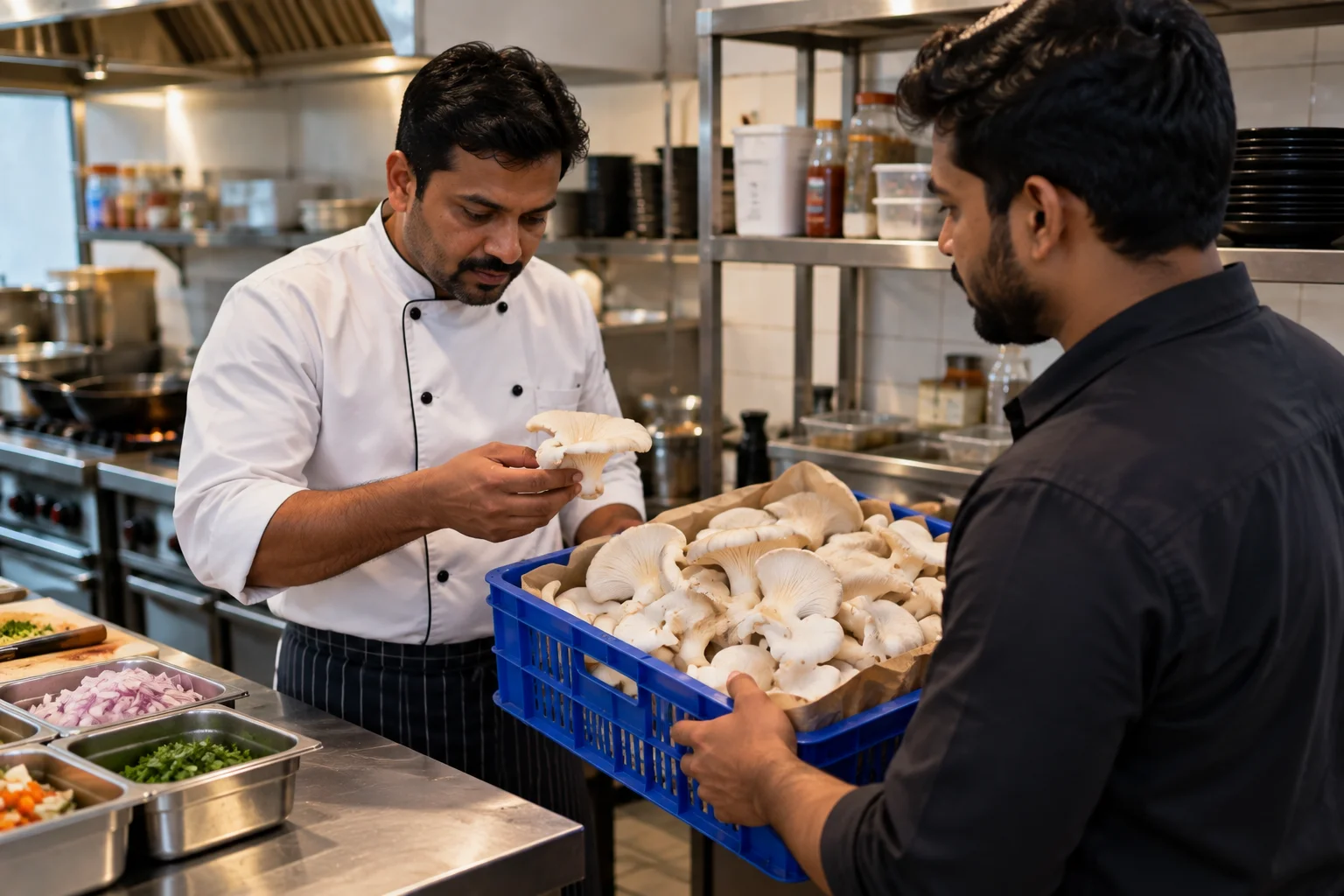
Chefs and restaurant owners do not buy mushrooms from WhatsApp flyers or cold phone calls. They buy based on gill freshness, cap thickness, stem trim, and whether you can show up at their kitchen back-door at 9:30 AM sharp every Tuesday and Friday.
Instead of asking a restaurant manager "Do you want to buy mushrooms?", follow this field routine:
Map a 15 km Radius: List every fine-dining restaurant, pure-veg family dhaba, Chinese/Continental cloud kitchen, and pizza outlet within a 30-minute ride from your farm.
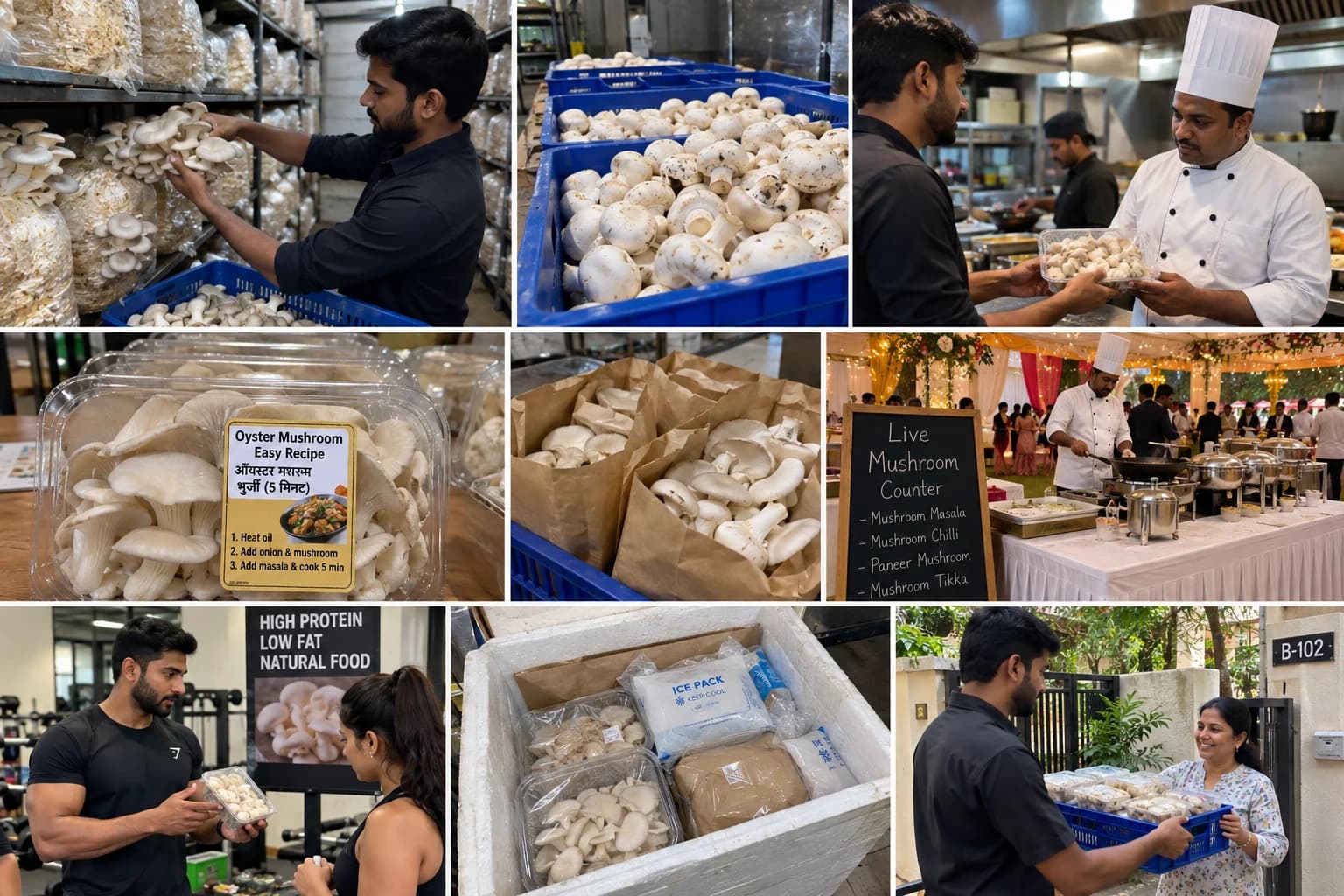
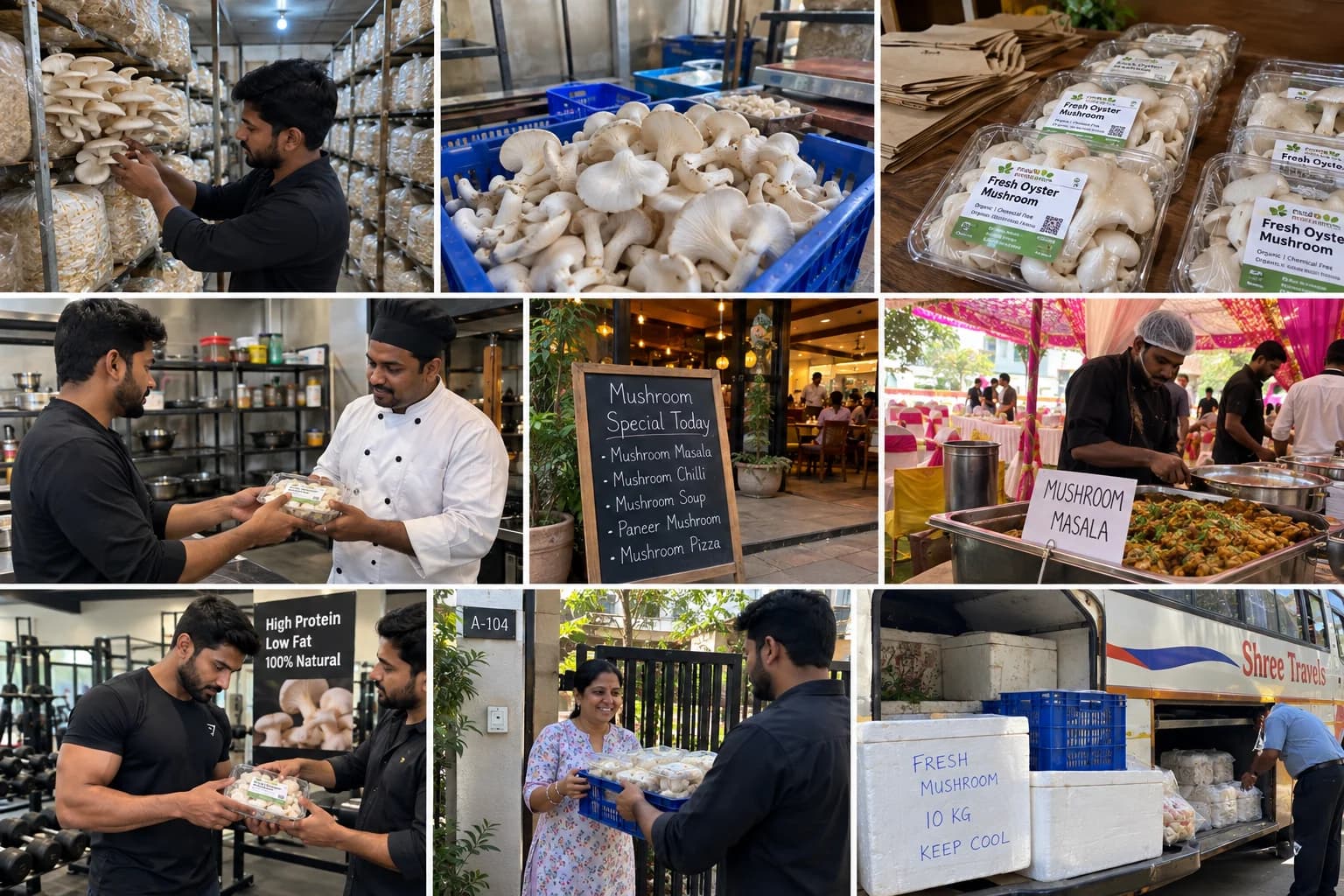
Pack 250g "Chef Samples": Take your best-grade harvest—cleanly cut stems, zero substrate specks, no yellowing edges. Pack them in breathable punnets or crisp brown paper bags (especially for Oyster mushrooms, which sweat and turn slimy in cheap sealed polythene).
Visit Between 2:30 PM and 4:30 PM: Never visit a restaurant during lunch or dinner rush. Walk straight to the kitchen purchase manager or head chef during their afternoon prep downtime.
The Pitch: Hand them the box and say, "Hamara local farm yahi paas mein hai. Aaj subah ka fresh harvest hai—Mandi ke stock se 2 din zyada chalega. Aap aaj kitchen mein try karke dekhiye, pasand aaye toh kal se regular rate pe baat karenge." (Our local farm is right nearby. This is this morning's harvest—it will last 2 days longer than Mandi stock. Try it in the kitchen today; if you like the quality, we’ll talk regular rates tomorrow.)
The Golden Rule of B2B: Chefs hate price fluctuations. In the Mandi, Button mushrooms might sell for ₹90/kg in January and ₹180/kg in March. Offer your restaurant buyers a fixed 6-month contract rate (for example, ₹150–₹170/kg year-round). They get predictable food costs; you get guaranteed cash flow.
3. Tap the Hidden Goldmine: Wedding Caterers & Tent Houses
In Tier-2 and Tier-3 towns across India, restaurants buy in small 2 kg to 5 kg batches, which can eat up your delivery fuel costs. Who buys 30 kg to 80 kg in a single order? Local wedding caterers.
Today, almost every wedding buffet has Mushroom Masala, Mushroom Chilli, or Paneer-Mushroom Tikka on the menu.
- Make a list of the top 20 catering contractors and marriage garden managers in your district.
- Do not wait for the wedding season (Shadi season) to start. Meet them 3 weeks before the auspicious dates begin, when they are finalizing their raw material vendors.
- Offer to supply pre-cleaned, bulk-packed 5 kg bags directly to the venue kitchen so their staff saves 2 hours of washing and trimming time.
4. How to Sell Oyster, Milky & Medicinal Mushrooms (The Education Gap)
Let’s be completely honest about the Indian market: Button mushrooms sell themselves; Oyster and Milky mushrooms require you to educate the buyer first.
If you walk into a standard grocery store with fresh Oyster mushrooms (Dhingri), the shopkeeper might look at it with suspicion because local housewives aren't used to its shape or texture. To move Oyster, Lion’s Mane, or Milky mushrooms fast, pivot your target audience:
Gyms, Yoga Studios & Dietitians: Partner with local gym trainers. Give them a ₹20 commission per packet sold to their clients. Gym-goers are tired of eating boiled soya chunks and expensive paneer every day—pitch fresh Oyster mushrooms as a clean, zero-fat, high-protein daily alternative.
The "Recipe Sticker" Trick: When selling punnets to retail vegetable carts or modern supermarkets, stick a small ₹1 printed label on top of the box with a 3-step recipe in Hindi and English ("5-Minute Crispy Oyster Mushroom Bhurji / Masala"). When a customer knows how to cook it like routine sabzi, their hesitation disappears.
Residential WhatsApp Groups: Don't spam. Find one resident inside a gated society or government colony, give them free mushrooms once a week, and make them your society aggregator. Drop 20 packets at their gate every Wednesday morning.
5. Free Digital Assets That Bring Inbound Bulk Buyers
You don't need a massive marketing budget to let wholesale buyers in nearby cities know you exist. Set up two free systems that work 24/7:
Google Business Profile (Local SEO Powerhouse): Don't just name your profile after your brand. Name it strategically: "[Brand Name] - Fresh Button & Oyster Mushroom Wholesale Supplier in [Your City]". Upload real photos of your growing bags, harvesting crates, and clean packaging every week. When a new cafe owner in town searches "fresh mushroom supplier near me" on Google Maps, your phone rings first.
IndiaMART & Justdial Listings: Register as a free seller for your district and neighboring districts. Be specific about your minimum order quantity (MOQ)—for example, "Minimum Order: 10 kg for inter-city bus parcel delivery." Pro tip: Use daily roadways buses to ship thermocol-iced boxes to buyers 50–100 km away for less than ₹100 per box in transport cost.
Frequently Asked Questions (FAQs)
Q: How can I sell fresh Oyster mushrooms if my local market only buys Button mushrooms?
Avoid wholesale vegetable mandis for Oyster mushrooms initially. Instead, sell directly to morning walkers outside parks, partner with local gym trainers to pitch it as a protein diet food, and supply Chinese/Pan-Asian cloud kitchens that prefer the texture of Oyster mushrooms in stir-fries and soups.
Q: What is the best packaging to increase the shelf life of fresh mushrooms for retail buyers?
For Button mushrooms, use 200g food-grade PP punnets wrapped with stretchable breathable cling film (poke 2–3 tiny pinholes to prevent condensation). For Oyster mushrooms, use brown kraft paper bags or ventilated clamshell boxes so moisture doesn't trap inside and turn the edges soggy.