The Complete Guide to Mushroom Farming Fogger Systems: Selection, Automatic Setup, and Troubleshooting
When new growers start mushroom farming, they usually begin by spraying water manually using a backpack knapsack sprayer or a handheld misting bottle. For the first 10 to 15 days, everything seems fine. However, as soon as pinheads (tiny mushroom primordia) begin to emerge, the real trouble starts—some pinheads turn yellow and dry up, while others develop brown spots (Bacterial Blotch) and Green Mold because heavy water droplets land directly on them.
This is exactly where a properly designed Fogger System (Misting System) changes the game. Mushrooms are roughly 90% water, and to grow rapidly, they do not need heavy water drops—they need moisture suspended in the air (Relative Humidity - RH). In this comprehensive, ground-reality guide, we will cover what a fogger is, how mist is created, which fogger suits each mushroom variety, how to make your setup 100% automatic, and how to fix common breakdowns yourself without calling a technician.

1. What is a Fogger and Why Do Mushroom Growers Use It?
A fogger is a micro-irrigation and humidification device that uses high water pressure to break water into such microscopic particles (microns) that instead of falling to the ground as water droplets, it floats in the air like thick fog or mist.
Mushroom growers install fogger systems for three major reasons:
During the fruiting stage, mushrooms require 80% to 90% RH. Manual spraying spikes humidity to 95% and drops back to 60% within an hour, causing caps to crack. A fogger maintains steady humidity.
During hot summer months or inside seasonal sheds, fine mist hanging in the air triggers Evaporative Cooling. This naturally brings room temperature down by 3°C to 5°C without an air conditioner.
Because heavy water droplets never pool on top of the mushroom caps, rotting and bacterial spotting are prevented. Additionally, it eliminates manual spraying 6 to 8 times a day.
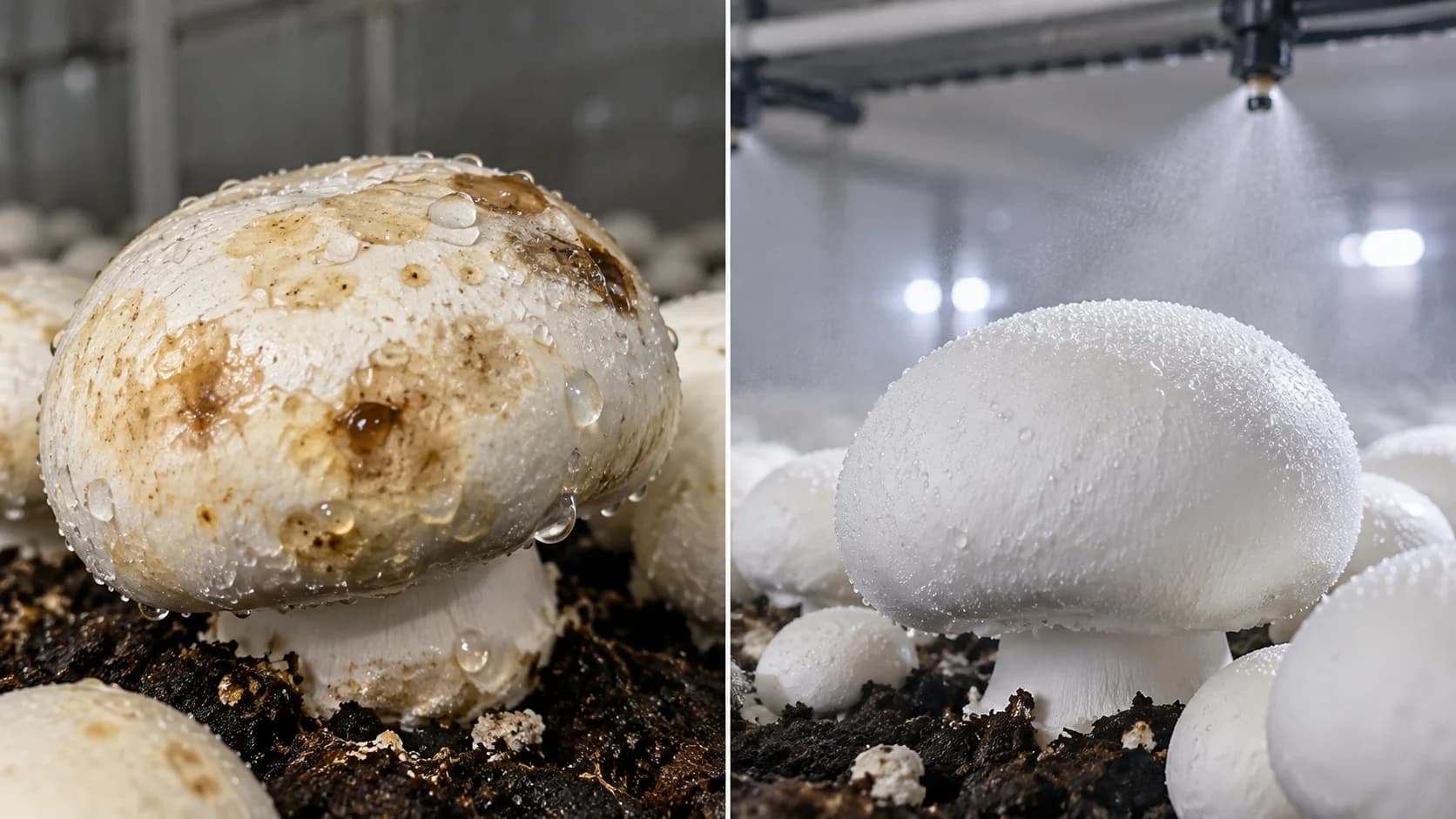
2. How Does a Fogger Work and How is Mist Created?
Many beginners assume a fogger has a heating element or gas inside to create smoke—which is completely untrue. The entire mechanism relies on Water Pressure (PSI/Bar) and the Nozzle Orifice (hole size):
3. Types of Fogger Systems in the Market (Which One is Right for You?)
Comparison and approximate costs of the 4 primary humidification systems used in mushroom cultivation
| System Name | Working Pressure | Droplet Size (Microns) | Best Suited For | Approx. Cost (India) |
|---|---|---|---|---|
| 1. Low-Pressure Plastic Fogger (4-Way / 1-Way) | 2.5 to 4 Bar (35–60 PSI) | 40 to 70 Microns | Seasonal Huts (Thatched Sheds), Oyster & Milky Mushrooms, Roof Cooling | ₹2,500 – ₹6,000 |
| 2. High-Pressure Misting System (Brass/SS Nozzle) | 40 to 70 Bar (600–1000 PSI) | 5 to 15 Microns (Dry Fog) | Button Mushrooms, Medium/Large Brick Rooms, Commercial Racks | ₹12,000 – ₹35,000 |
| 3. Ultrasonic Industrial Humidifier | Electricity (Piezo Plate + Fan) | 1 to 5 Microns (Zero Water Drops) | Commercial PUF Panel Rooms, Lion's Mane, Cordyceps, Shiitake | ₹14,000 – ₹45,000 |
| 4. Spinning Disc / Centrifugal Humidifier | Motor + Rotating Disc | 20 to 40 Microns | Small Enclosed Rooms, Spawn Labs, or Incubation Areas | ₹4,500 – ₹9,000 |
4. The Real Game of Fogger Nozzles and Anti-Drip Valves
Even if you buy the best motor and pipeline, choosing the wrong nozzle will drench your entire mushroom farm in standing water.
Types of Nozzles:
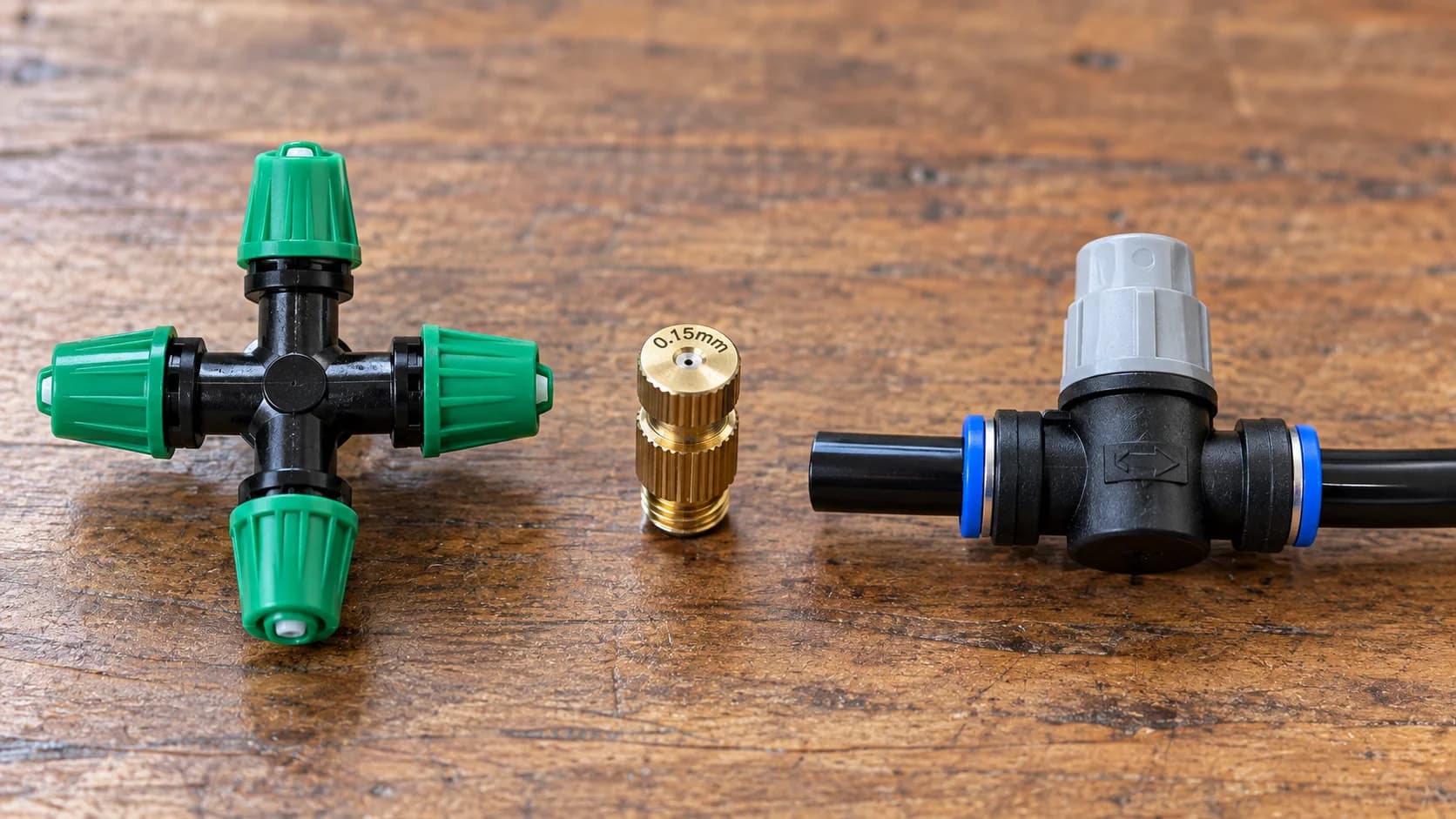
Features four spray outlets pointing in all four directions. It covers a wide area on a low budget, though its droplet size is slightly larger (40–70 microns).
Useful for narrow walkways or compact rack spaces with focused single-direction spray.
Stamped with specific orifice ratings (0.1mm, 0.15mm, 0.2mm, 0.3mm). Choose 0.1mm or 0.15mm inside growing rooms for ultra-fine "Dry Fog" that doesn't wet your palm.
What is an Anti-Drip Valve (LPD - Leak Prevention Device)?
When you switch off the fogger pump, the residual water trapped inside the overhead pipeline loses pressure and starts dripping ("tap-tap") out of the nozzles directly onto the mushroom bags below. To prevent this, a small spring-loaded Anti-Drip Valve is attached right before every nozzle. As soon as line pressure drops below 1.5 Bar, the internal spring snaps shut and stops every single drop from leaking.
5. Which Fogger Machine (Pump) is Used and How Does It Work?
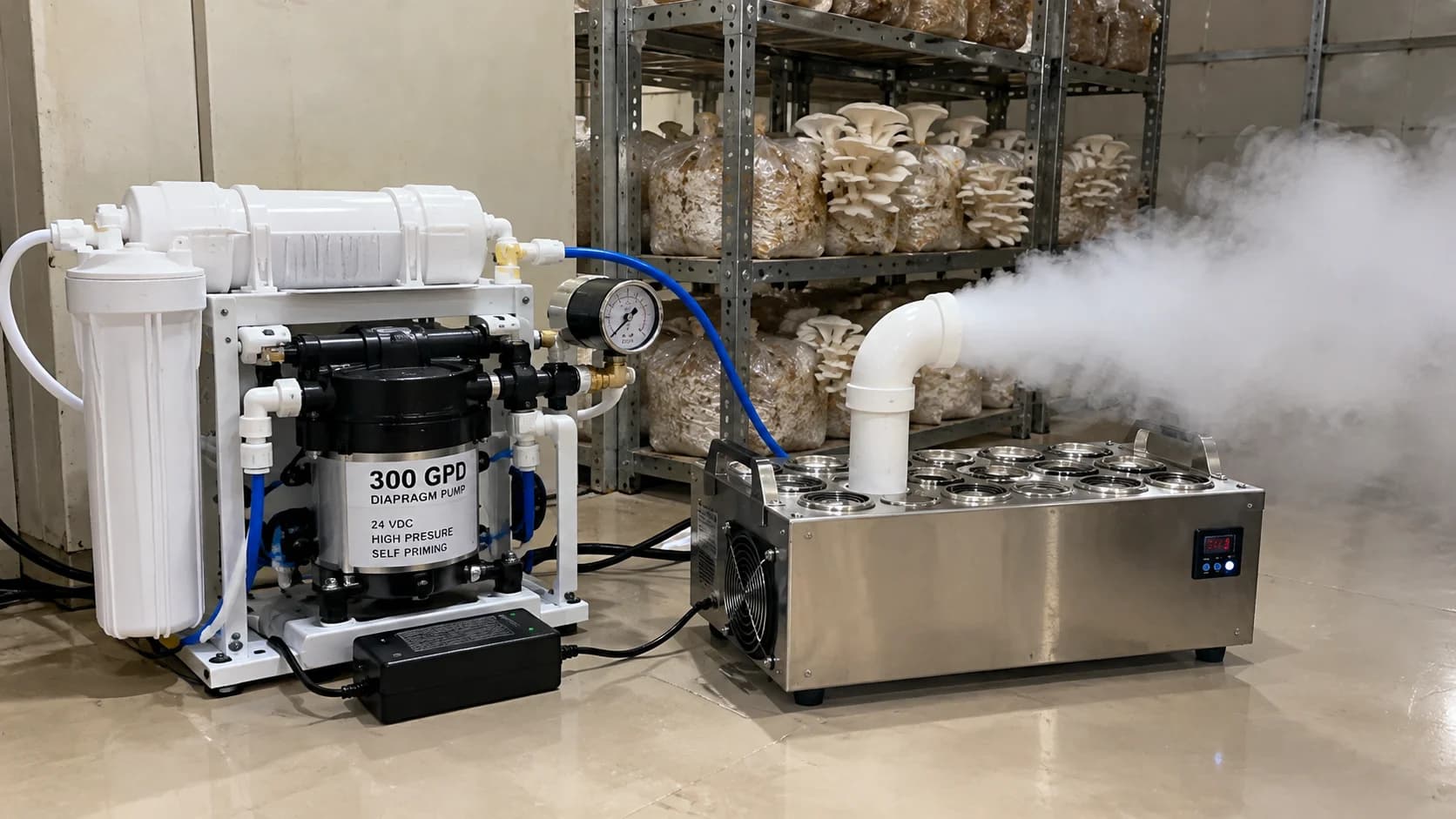
The heart of a fogger system is its High-Pressure Pump. Depending on your growing room capacity, you can choose from three main setups:
Best For: Small to medium setups running 10 to 40 fine mist nozzles.
How It Works: Heavy-duty booster pump used in commercial RO water plants, powered by an AC-to-DC SMPS adapter. Operates quietly, uses minimal electricity, and generates 100 to 130 PSI.
Best For: Large farms running 50 to 200+ fine mist nozzles across 3 to 4 rooms.
How It Works: Built with a brass head and ceramic pistons, pressure gauge, and unloader valve to dial in 500 PSI to 1000 PSI.
Best For: Commercial PUF panel clean rooms (Lion's Mane, Shiitake).
How It Works: Submerged piezo ceramic discs vibrate at ultrasonic frequencies to create cool smoke-like fog, pushed through PVC pipes by a waterproof blower.
6. Which Fogger Should You Use for Different Mushroom Varieties?
Every mushroom species has a different skin texture and tolerance for surface moisture:
Button mushroom casing soil needs steady moisture, but once pinheads form, water droplets must never sit on the caps—otherwise, they develop yellow/brown spots (Bacterial Blotch). High-Pressure Fine Mist (0.15mm nozzles) or an Ultrasonic Humidifier is best here.
Oyster mushrooms are resilient and demand high fresh air along with high humidity. You can easily use a 4-Way Plastic Fogger (with Anti-drip valves) or a 300 GPD Diaphragm Pump misting kit.
Grown in high temperatures (30°C–35°C), room moisture evaporates rapidly. Here, a 4-Way Fogger works great to keep the casing layer moist and cool down the room temperature.
Lion's Mane has delicate icicle-like spines. Heavy water droplets rot the fruiting body (use Ultrasonic Humidifier only). Shiitake blocks need 85%–90% RH during pinning and 75% RH during maturation with fine mist brass nozzles.
7. How to Use Foggers in a Seasonal Hut, Normal Room, and Commercial PUF Panel Plant
A. Seasonal Hut / Bamboo & Thatched Shed (Jhopdi)
Inside the Hut: Hang 4-Way Anti-drip Foggers along the central walkway ceiling at 6-foot intervals. Never mount foggers right against the top bags on the racks, or the upper tier bags will get waterlogged.
B. Normal Cement / Brick Room
Concrete floors do not absorb water like mud floors in seasonal huts. If you install heavy agricultural 4-way foggers indoors, water will pool on the floor and breed flies. The Right Way: Install a 300 GPD Pump + 8mm PU Pipe + 0.15mm Slip-lock Brass Nozzles. Point nozzles into the central walkway passage rather than directly at bags so mist dissolves into the air.
C. Commercial AC Plant (PUF Panel Growing Room)
Commercial PUF panel rooms have racks stacked 5 to 6 tiers high with an overhead AHU poly-duct running along the ceiling. The Right Way: Place an Ultrasonic Humidifier or High-Pressure SS Fogger Array directly in front of the Blower Duct outlet. The blower carries dry fog evenly to every corner—from the top tier down to the bottom rack.

8. Step-by-Step Installation: How to Install a Fogger System Yourself
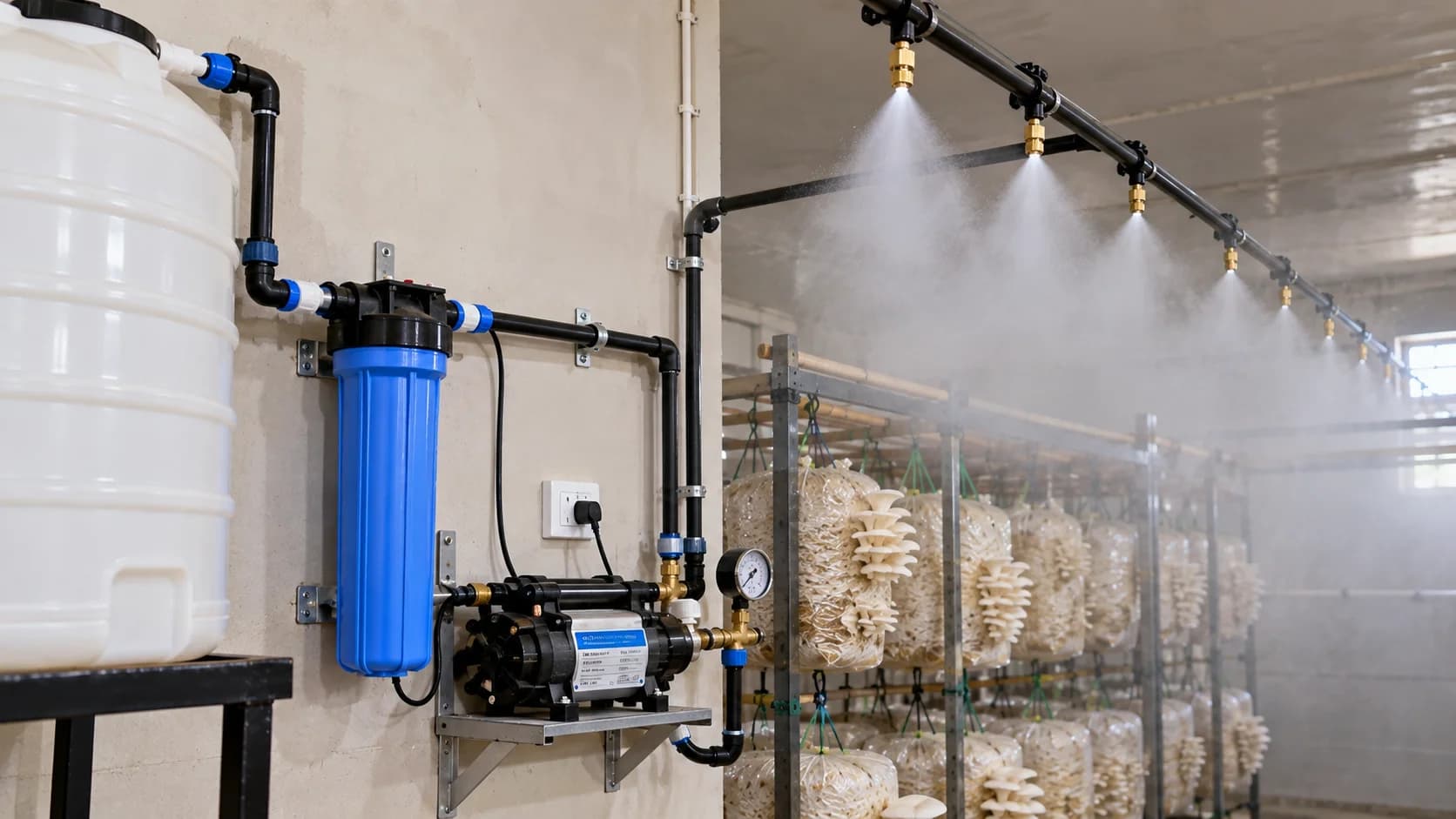
You can set up your own fogger system in under an hour without hiring a plumber. Follow this exact connection sequence:
- Clean Water Tank: Use a plastic water tank filled with low-TDS water (ideally under 150 ppm).
- Double Sediment Filter: Immediately after the tank outlet, install a 10-inch Spun/Sediment Filter housing. This traps sand, silt, and debris before it can ever reach and clog your tiny nozzles.
- High-Pressure Pump & Solenoid Valve: Connect the filter outlet to the pump inlet. Install a Solenoid Valve (SV) alongside the pump so that when the motor turns off, gravity flow from the water tank is completely blocked.
- Main Pipeline (PU Pipe or LLDPE Pipe): String an 8mm PU Pipe (for slip-lock mist systems) or a 16mm LLDPE Lateral Pipe (for 4-way foggers) along the ceiling supported by a taut nylon wire.
- Connectors + Anti-Drip + Nozzle: Insert push-fit T-connectors every 4 to 5 feet, attach the Anti-Drip valves, and press in the nozzles.
- Flushing (The Most Crucial Step): Before screwing in the final nozzles and end-plug, turn on the pump for 1 full minute. This flushes out any tiny plastic shavings left inside the pipe from cutting. Once flushed, cap the end-plug and attach all nozzles.
9. When Should You Turn the Fogger ON and OFF?
Since bags are closed or covered, run the fogger minimally (just enough to maintain 65%–70% ambient RH).
Pinheads are highly sensitive to dehydration and require 85% to 90% RH. Run the fogger in short, frequent bursts.
Maintain relative humidity between 80% and 85% consistently to support healthy mushroom cap expansion.
Switch the fogger completely OFF! If you harvest wet mushrooms and seal them inside polythene packets, they will turn slimy, brown, or black within 24 hours. Harvesting dry mushrooms extends shelf-life by 3 to 4 days.
10. How to Make Your Fogger Fully Automatic (Timer vs. Controller: The Real Truth)
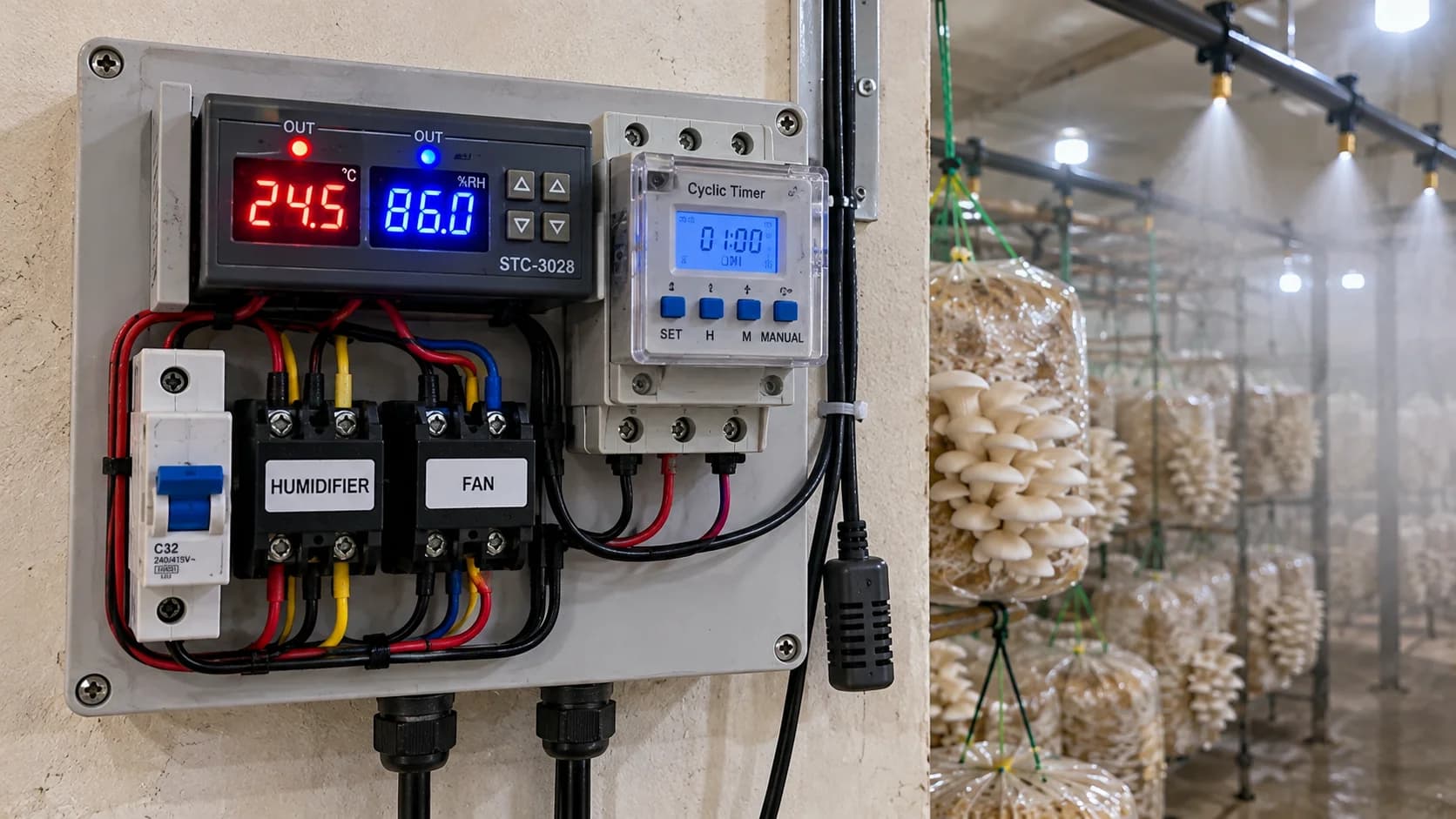
To avoid manually flipping switches day and night, you can automate your fogger using two devices:
Devices like the STC-3028, XH-W3005, or industrial units from Multispan/Selec come with a sensor probe hung inside the room. Set minimum/maximum thresholds (e.g., Turn ON at 80% RH and Turn OFF at 88% RH).
Has no sensor. Program an ON Duration and an OFF Interval (e.g., "Run fogger for 30 seconds, then stay OFF for 15 minutes"). Repeats 24/7 without fail.
Pros of Automation & The Biggest Hidden Problem (That Nobody Talks About!):
Pros: Humidity never drops at night, prevents over-spraying, and saves electricity and labor.
The Biggest Problem (Sensor Saturation Failure): When budget humidity sensors (₹300–₹600) stay exposed to 90% humidity and dense mist continuously, microscopic water condensation gets trapped inside the sensor. The display freezes at 99% RH (fogger never turns on, drying out your crop) or malfunctions and runs non-stop, flooding your growing room!
Pro Solution (The Combo Setup):
Wire a Humidity Controller and a Cyclic Timer in series. Whenever room humidity drops below 80%, the humidity controller sends power to the Cyclic Timer—which runs the fogger for just 30–40 seconds and then pauses for 5 minutes to let mist disperse evenly before checking humidity again. Your sensor will never get waterlogged!
11. Pros and Cons of a Mushroom Fogger System
- Uniform mushroom size, smooth caps, and superior snow-white color.
- Reduces pinhead drying (Pinning Abortion) by up to 90%.
- Low maintenance for 3 to 4 years once installed properly.
- Can occasionally distribute water-soluble organic preventatives (though clean water is always recommended).
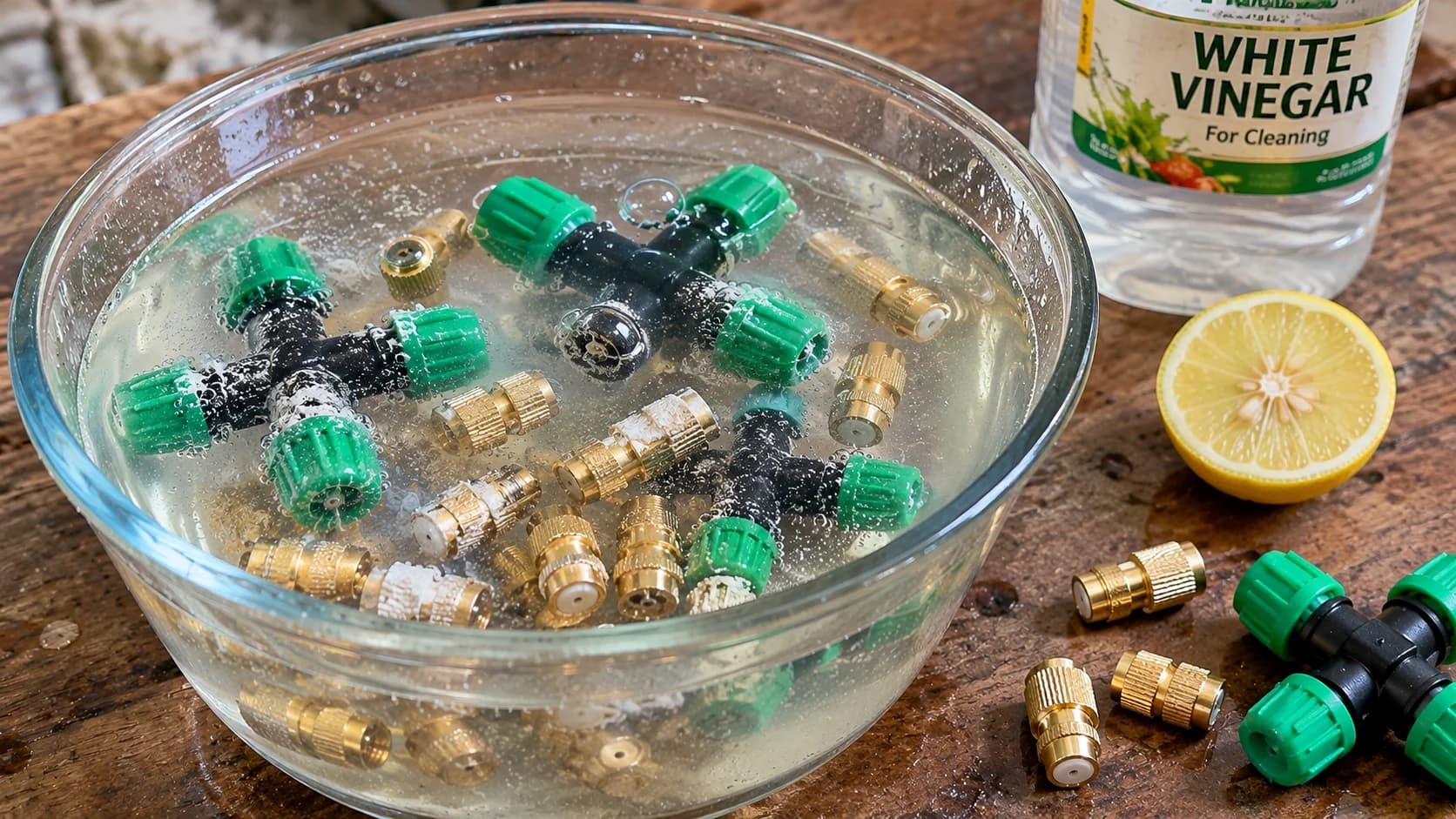
- Nozzle Choking: Hard water minerals (calcium/lime scale) easily block microscopic nozzle holes.
- Dripping Issues: Worn-out anti-drip springs cause localized water dripping on bags directly underneath.
- High Humidity + Zero Fresh Air = Green Mold: Running fogger constantly without exhaust venting CO2 triggers Trichoderma and Cobweb Mold.
12. DIY Troubleshooting: How to Fix a Broken Fogger System at Home
Field-tested quick fixes for the 4 most common fogger system failures
| Problem | Root Cause | DIY Fix (At Home) |
|---|---|---|
| 1. Nozzle shoots a straight stream of water or is completely blocked | Hard water calcium/salt scale has clogged the tiny orifice | Never poke a sewing needle or wire into the nozzle! That permanently ruins the micron hole size. Unscrew all nozzles and soak them in a bowl of Warm Water + White Vinegar (or Citric Acid / Lemon Salt) for 2 hours. The mineral scale dissolves completely. |
| 2. Water keeps dripping from nozzles after the pump is turned off | Debris stuck inside the Anti-Drip valve or a weakened internal spring | Twist open the anti-drip valve, wipe the small rubber washer clean, gently stretch the stainless spring slightly to restore tension, and reassemble. |
| 3. Pump motor is running, but there is no mist pressure in the pipe | Clogged pre-filter cartridge or an Air-Lock inside the pump head | First, inspect and replace the 10-inch spun filter candle. Next, disconnect the outlet pipe right at the pump head and run the motor for 10 seconds to bleed out trapped air. |
| 4. Ultrasonic Humidifier is producing very little fog | Scale buildup on piezo ceramic discs, or water level in the tank is too deep | Gently brush the ceramic discs with a soft toothbrush dipped in vinegar. Check the float valve—the water level above the ultrasonic plate must be strictly 2 to 3 cm deep (if water is too deep, fog cannot rise). |
13. Where to Buy and Best Fogger Brands in India
- 4-Way & Agricultural Foggers: Jain Irrigation, Netafim, Rivulis, Automat, Finolex Plasson.
- High-Pressure Misting & Slip-Lock: Automist, Agripulse, TrueMist, Mistcooling India.
- Diaphragm Pumps (100–500 GPD): Kemflo, Lexpure, Grand Forest, Cruze.
- Automatic Timers & Controllers: Selec (Cyclic Timer XT546 / 800XC), Multispan (HTC-1102), Subzero, STC-3028 (Budget-friendly).
Offline: Visit any local Agricultural Drip Irrigation Dealer (Krishi Seva Kendra) in your city to get authentic Jain or Netafim 4-way foggers and 16mm lateral pipes at wholesale rates (₹15–₹25 per fogger). For 100/300 GPD pumps and spun filters, your local Wholesale RO Spare Parts Market gives much cheaper rates than online stores.
Online: IndiaMART (best for bulk fittings and stainless ultrasonic humidifiers), Amazon/Flipkart (DIY misting kits and STC-3028 controllers), or BigHaat / AgroStar.
14. 3 Secret Expert Tips (To Boost Your Mushroom Yield by 30%)
Many growers turn on their exhaust fan to remove CO2 while the fogger is actively misting. The result? The exhaust fan immediately sucks all the fresh mist right out of the room within 60 seconds! Always run your exhaust fan for 10 minutes first to flush out CO2, shut the exhaust off, and immediately run your fogger for 30–40 seconds.
If your borewell water has a TDS above 250 ppm, use RO-filtered water for your fogger tank. Hard water not only clogs nozzles every week, but it also leaves a chalky white mineral dust on top of maturing mushrooms, lowering their market value.
Always hang your fogger pipeline at least 1.5 to 2 feet above the highest row of mushroom bags. This gives the fine mist enough vertical space to evaporate and blend into the room air before settling down.
Frequently Asked Questions (FAQs)
Q1. How many fogger nozzles are needed for a 10x10 ft mushroom room?
In a 10x10 feet (100 sq. ft.) growing room, 4 to 6 four-way plastic foggers are sufficient. If you are installing 0.15mm single brass fine-mist nozzles, 8 to 10 nozzles paired with a 100 GPD or 300 GPD diaphragm pump will give you uniform humidity coverage.
Q2. Can I use a desert air cooler instead of a fogger system?
In a tiny hobby Oyster mushroom room, an air cooler without pads can add some moisture, but traditional desert cooler grass/honeycomb pads quickly become a breeding ground for Green Mold (Trichoderma) spores and mosquitoes. When the cooler fan blows, it blasts mold spores across every single mushroom bag in your room. A clean-water pressurized fogger system is far safer and more hygienic.
Q3. How much does it cost to build a complete automatic fogger system?
For a medium-sized growing room (capacity of 200 to 300 bags), a complete DIY setup—including a 300 GPD Pump + SMPS Adapter + 15 Brass Nozzles + 8mm PU Pipe + 10-Inch Filter + Automatic Controller/Timer—costs approximately ₹3,500 to ₹5,500 in total.
Mushroom Climate Control & Farm Setup Practical Training
Join us at Organic Mushroom Farm, Katangi, Jabalpur (M.P.) to learn live fogger installation, AC room climate automation, spawn production masterclasses, and commercial high-yield methods.