Commercial AC Button Mushroom Plant Setup in Delhi NCR: Complete Cost Breakdown, Electricity Math & Practical Training Guide
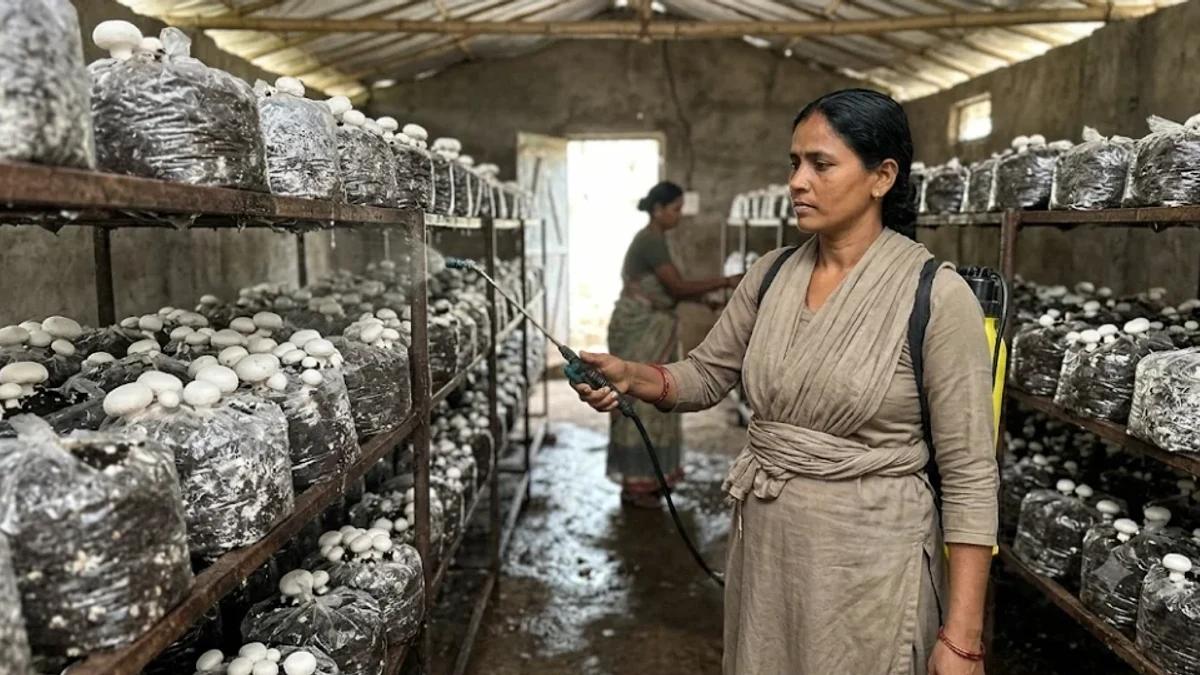
Every month, we meet business owners, retired professionals, and landowners from Outer Delhi, Dwarka border, Rohini, and nearby NCR towns who want to skip small single-room trials and directly set up a year-round Commercial AC Button Mushroom Plant.
Their logic is simple: during winter (December and January), seasonal button mushrooms flood Azadpur Mandi and wholesale prices touch ₹85 to ₹100 per kg. But from March to October, when Delhi's temperature crosses 35°C to 45°C, seasonal huts shut down completely—and climate-controlled AC mushroom farms sell their harvest for ₹150 to ₹210 per kg.
However, setting up an AC mushroom unit is not as simple as buying two split air conditioners and fitting them inside a brick room. Over the years, during our commercial mushroom farming training programs, we have rescued dozens of half-built farms in Delhi NCR where investors wasted ₹3 Lakh to ₹5 Lakh on the wrong cooling machinery and faulty room insulation.
Here is the real, engineering-grade breakdown of what it actually takes to build and run a profitable climate-controlled button mushroom unit in Delhi NCR.
1. Why Normal Household Split ACs Fail Inside a Mushroom Growing Room
Before spending a single rupee on machinery, you need to understand this scientific difference:
- A domestic Split AC is designed to DRY the air. When you turn on a normal AC in your bedroom, it drops the humidity to 40%–50% so humans feel comfortable.
- Button mushrooms need the exact opposite—16°C temperature WITH 85% to 90% relative humidity.
If you install normal household split ACs in a commercial mushroom room:
- The AC coils will constantly pull moisture out of your casing soil, turning your mushroom pinheads dry, scaly, and brown.
- The high humidity and spores inside the mushroom room will choke the small indoor AC fins and burn out the PCB circuit board within 6 months.
What We Teach in Our Commercial Mushroom Training: Instead of standard home ACs, a commercial growing room requires a Heavy-Duty Ductable Chiller / High-CFM Cooling Unit paired with a Fresh Air Handling System (FAHU / Exhaust-Damper Assembly) and Ultrasonic Mist Humidifiers so cooling and moisture work together instead of fighting each other.
2. Room Construction: PUF Panel Room vs. Insulated Brick Room in Delhi
In Delhi's extreme 45°C summer heat (especially in open areas like Narela, Bawana, Najafgarh, Chhatarpur, or Badarpur), poor wall insulation will double your monthly electricity bill. You have two proven construction choices:
| Feature | Option A: Pre-Fabricated PUF Panel Room | Option B: Double Brick Wall + Thermocol/XPS Insulation |
|---|---|---|
| Insulation Material | 60 mm to 80 mm Polyurethane Foam (PUF) sandwich sheets | 9-inch brick wall + bitumen coat + 50 mm high-density Thermocol/XPS + plaster |
| Heat Retention (R-Value) | Superior: Zero thermal leakage; cuts compressor running time by 35% | Good: Works well if already using an existing warehouse or basement |
| Construction Speed | Ready in 7 to 10 days; can be dismantled and shifted if land is rented | Takes 30 to 45 days; permanent civil structure |
| Hygiene & Contamination | Smooth GI coated surface—easy to wash with formalin; zero fungal hiding spots | Porous cement walls need annual lime-wash and anti-fungal sealing |
3. Complete Setup Cost: 1-Ton vs. 2-Ton AC Button Mushroom Plant in Delhi NCR
In commercial mushroom language, plant capacity is measured either by Compost Capacity (in Tons) or Growing Room Size. Below is the realistic cost estimate for a Single Growing Room holding 10 to 12 Tons of Compost (800 to 1,000 Bags), which produces roughly 2,000 kg to 2,400 kg of fresh Button Mushrooms per 60-day cycle:
| Expense Component | Technical Specification | Estimated Cost (INR) |
|---|---|---|
| 1. Room Size & Structure | 40 ft (L) × 18 ft (W) × 13 ft (H) using 60mm PUF Panels (or existing hall insulation) | ₹2,20,000 – ₹3,10,000 |
| 2. Commercial Cooling Unit | 5.5 TR to 7.5 TR Commercial Ductable / Chiller Unit with Copper Condenser | ₹1,65,000 – ₹2,25,000 |
| 3. Heavy-Duty Galvanized Racks | 5-Tier Rust-Proof GI Pipe Racks (4 ft width, 1.8 ft shelf gap) | ₹85,000 – ₹1,15,000 |
| 4. CO2 Sensor, Exhaust & FAHU | Digital CO2 Controller (ppm meter), insulated fresh air intake & exhaust dampers | ₹35,000 – ₹50,000 |
| 5. Industrial Ultrasonic Humidifier | Automatic 90% RH mist maker with float valve & RO water filter | ₹18,000 – ₹28,000 |
| 6. Raw Material (First Cycle) | 10 Tons Pasteurized Compost + 70 Kg Lab-Tested Button Spawn + Casing Soil | ₹1,10,000 – ₹1,35,000 |
| Total Turnkey Setup Cost (1 Room) | Complete Ready-to-Grow Commercial Unit | ₹6.35 Lakh – ₹8.60 Lakh |
(Pro Tip from Our Training: Always plan for a 2-Room Staggered Model once your first room stabilizes. With 2 rooms running on a 30-day gap, you harvest fresh mushrooms every single day of the year without breaks, and both rooms can share a standby backup compressor).
4. Solving the 3 Biggest Technical Problems in AC Mushroom Plants
Even with ₹8 Lakh worth of machinery, your yield depends on how you manage the room's internal climate at each stage. Here are the 3 problems our practical mushroom cultivation course trains you to solve effortlessly:
Problem 1: Mushroom Stems Getting Long (Drumstick Shape) & Caps Opening Early
Why It Happens: During the pinning stage (Days 22–26 after casing), new growers keep the room doors shut to save electricity. Carbon Dioxide (CO2) rises above 2,500 ppm. High CO2 tricks the mushroom into thinking it is still buried deep underground, so it stretches its stem upward looking for fresh air, resulting in thin, low-grade mushrooms that fetch ₹30/kg less in Azadpur Mandi.
The Scientific Fix: On day 7–9 after casing (Pinning Initiation), we drop the room temperature from 24°C down to 16°C–17°C over 48 hours AND open the fresh air damper to bring CO2 levels down between 800 ppm and 1,000 ppm. This sudden cold-plus-oxygen shock triggers thousands of tight, heavy, snow-white button pinheads across the entire bed.
Problem 2: Brown Spots on Mushrooms (Bacterial Blotch / Pseudomonas tolaasii)
Why It Happens: If your humidifier sprays large water droplets that stay sitting on top of the mushroom cap for more than 3 hours without evaporating, yellow-brown sunken spots appear overnight.
The Scientific Fix: Never run the humidifier without gently circulating the air for 15 minutes right after watering, and always maintain a 150 ppm chlorine dioxide or stabilized bleaching solution protocol during post-flush watering as taught in our SOP manual.
Problem 3: High Electricity Bills in Delhi NCR
How to Keep Power Bills Low:
- Do not run the cooling compressor during the first 14 days of Spawn Run and 7 days of Case Run—during those 21 days, the mycelium needs 24°C to 25°C, which requires almost zero AC load in spring, autumn, and winter.
- Schedule heavy fresh-air exchanges (CO2 flushing) early in the morning (4:00 AM to 6:00 AM) and late at night when outside Delhi air is naturally cooler, saving 25% compressor load.
- Apply for an Agro-Industrial / MSME / Horticulture Electricity Connection (available in rural/outer revenue belts of Delhi NCR) instead of a standard commercial shop meter.
5. Yearly Profit & ROI Calculation (10-Ton Single Room Unit)
- Number of Crop Cycles per Year: 5.5 to 6 Cycles (Each cycle takes 55–60 days using readymade Phase-II/Phase-III compost).
- Average Mushroom Yield per Cycle (20%–22% of Compost Weight): 2,000 kg to 2,200 kg.
- Total Yearly Production: ~12,000 kg (12 Tons).
- Average Wholesale Selling Price in Delhi (Year-Round Average): ₹135 / kg (Winter: ₹100/kg; Summer/Monsoon: ₹160–₹190/kg).
- Gross Annual Revenue: ₹16,20,000.
- Total Operating Expenses (Compost, Spawn, Electricity, Labor, Packing @ ₹80/kg): ₹9,60,000.
- Net Annual Profit (Single Room): ₹6,60,000 (Approx. ₹55,000/month net profit from just one room—recoverable in 12 to 14 months!)
Frequently Asked Questions (Commercial AC Plant Queries)
Q1: Can I take commercial mushroom training before buying the AC machinery?
A: Yes, and you definitely should! Spending ₹2,000–₹5,000 on our Certified Commercial Mushroom Training Course before investing ₹7 Lakh in machinery saves you from buying overpriced or incompatible chillers and gives you the exact layout blueprint.
Q2: Where do AC plant owners in Delhi buy 10 tons of ready compost?
A: If you don't have your own composting yard, we connect our trained students with verified Phase-II pasteurized bulk compost suppliers located along the Sonipat, Panipat, and western UP highway belt who deliver straight to your Delhi farm gate by truck.
Q3: Does Organic Mushroom Farm provide turnkey AC room design and bulk spawn supply?
A: Yes! Visit organicmushroomsfarm.com to join our commercial training batch, get your Bank Loan DPR (Detailed Project Report) prepared for the 35% PMFME Subsidy, and book bulk first-generation U-3 / S-11 Button Mushroom Spawn.